DEF 14A: Definitive proxy statements
Published on March 11, 2026
______________________________________________________________________________________________________
UNITED STATES
SECURITIES AND EXCHANGE COMMISSION
Washington, DC 20549
______________________________________________________________________________________________________
SCHEDULE 14A
Proxy Statement Pursuant to Section 14(a) of the
Securities Exchange Act of 1934
(Amendment No. )
______________________________________________________________________________________________________
Filed by the Registrant x Filed by a Party other than the Registrant ☐
Check the appropriate box:
☐ | Preliminary Proxy Statement | |||||||
☐ | Confidential, for Use of the Commission Only (as permitted by Rule 14a-6(e)(2)) | |||||||
x | Definitive Proxy Statement | |||||||
☐ | Definitive Additional Materials | |||||||
☐ | Soliciting Material under § 240.14a-12 | |||||||
(Name of Registrant as Specified in its Charter)
(Name of Person(s) Filing Proxy Statement, if Other Than the Registrant)
Payment of Filing Fee (Check all boxes that apply):
x | No fee required | |||||||||||||
☐ | Fee paid previously with preliminary materials | |||||||||||||
☐ | Fee computed on table in exhibit required by Item 25(b) per Exchange Act Rules 14a-6(i)(1) and 0-11 | |||||||||||||
LETTER FROM OUR FOUNDER, CHAIRMAN AND CHIEF EXECUTIVE OFFICER
We are pleased to invite you to our 2026 annual meeting of stockholders, which will be held virtually by webcast on April 22, 2026, at 9:30 a.m. Central Time. The enclosed notice of annual meeting and proxy statement describe the items of business we will conduct at the meeting and provide information about Life Time, including our practices in the areas of corporate governance and executive compensation. We encourage you to read these materials before you vote your shares.
As a premier lifestyle and leisure brand offering premium health, fitness and wellness experiences to a community of nearly 1.6 million individual members, we are a leading innovator in the industry and have earned the trust of our members for over 30 years to make their lives healthier and happier. To that end, we had another great year in 2025 as our members continue to desire our premium athletic country clubs, programs, services, products and events, and our team delivered in each of these areas throughout the year. With higher member engagement, increased dues revenue per membership, and robust in‑center revenue growth, we achieved our objectives and exceeded our financial goals.
We have stepped into 2026 with strong fundamentals and a clear path to expand the number of our clubs as we target higher income members and higher average annual revenue per center membership. We opened 10 new clubs in 2025, which were smaller clubs on average than we have historically opened. We are excited for 2026 with our accelerated new club growth focused on our large-format athletic country clubs. We expect to add nearly as much new square footage in 2026 as the previous two years combined. We also remain focused on growing our revenue and profitability by further increasing member engagement, optimizing our membership mix, and growing revenue per center membership. We are excited about the many opportunities to expand our business, including our in-center businesses with pickleball, Dynamic Personal Training, small group training, ARORA and our newly introduced CTR and LT Games, as well as our continued development of our digital app, including artificial intelligence such as L•AI•C, our first generative, artificial intelligence driven healthy way of life personal companion with personalized content and recommendations.
Our strong operating performance is generating significant cash flow and with a conservative balance sheet and robust sale-leaseback market, we have exceptional financial flexibility. This position of strength allows us to fund our growth while meeting our leverage targets and initiating a $500 million share repurchase program.
We remain grounded in our more than 30-year commitment to provide our members with unparalleled experiences through our comprehensive Healthy Way of Life ecosystem. We also believe in strong governance and integrity, operating from the member point of view and being a place for everyone with these steadfast commitments:
•upholding a culture of care that ensures our team and members are welcomed, supported, respected, recognized and empowered;
•operating in ways that protect the health of our communities and planet; and
•ensuring Life Time continues to be one of the most trusted and loved premium healthy lifestyle and leisure brands.
We could not be more excited about the future that lies ahead. Our leadership team and board of directors remain as committed as ever to grow long-term value in our company and we believe we are well positioned for success. Thank you for investing in us.
Bahram Akradi
Founder, Chairman and Chief Executive Officer
Life Time Group Holdings, Inc.
LIFE TIME GROUP HOLDINGS, INC.
______________________________________________________________________________________________________
NOTICE OF ANNUAL MEETING OF STOCKHOLDERS
TO BE HELD ON APRIL 22, 2026
______________________________________________________________________________________________________
March 11, 2026
Dear Stockholder:
You are cordially invited to attend the 2026 annual meeting of the stockholders (the “Annual Meeting”) of Life Time Group Holdings, Inc., a Delaware corporation (“we,” “us,” “Life Time” or the “Company”). The Annual Meeting will be held in a virtual meeting format on Wednesday, April 22, 2026 at 9:30 a.m. (Central Time) for the following purposes:
1. To elect the five nominees for Class II director to serve until the 2029 annual meeting of stockholders and until their successors are duly elected and qualified. The nominees for election are Joel Alsfine, Jonathan Coslet, J. Kristofer Galashan, Stuart Lasher and Jennifer Pomerantz.
2. To hold an advisory (non-binding) vote to approve the Company’s named executive officer compensation (referred to as the “Say-on-Pay Vote”).
3. To ratify the selection of Deloitte & Touche LLP as the Company’s independent registered public accounting firm for the fiscal year ending December 31, 2026.
4. To conduct any other business properly brought before the Annual Meeting or any adjournments or postponements thereof.
These items of business are more fully described in the proxy statement accompanying this Notice of Annual Meeting of Stockholders.
The record date for the Annual Meeting is February 23, 2026 (the “Record Date”). Only stockholders of record at the close of business on the Record Date may vote at the Annual Meeting or any adjournments or postponements thereof.
The Annual Meeting will be held in a virtual meeting format only, via the internet, with no physical in-person meeting. You will be able to attend and participate in the Annual Meeting online by visiting
www.virtualshareholdermeeting.com/LTH2026, where you will be able to attend, vote and submit questions via the internet similar to attendance at an in-person meeting. If you plan to participate in the virtual Annual Meeting, please see the Questions and Answers section below for further information.
Your vote is important. Whether or not you plan to attend the Annual Meeting, please vote your shares of common stock by telephone or via the internet promptly. Voting your shares promptly will ensure the presence of a quorum at the Annual Meeting and will save us the expense of further solicitation.
Please vote your shares by following the instructions for voting on the Important Notice Regarding the Internet Availability of Proxy Materials. You may submit your vote by telephone or via the internet, or if you received printed copies of the proxy materials, you may submit your vote by signing, dating and returning your proxy card by mail.
By Order of the Board of Directors
Erik Lindseth
Senior Vice President, General Counsel and Corporate Secretary
Chanhassen, Minnesota
Table of Contents
______________________________________________________________________________________________________
Page | |||||
Life Time Group Holdings, Inc.
2902 Corporate Place
Chanhassen, Minnesota 55317
______________________________________________________________________________________________________
PROXY STATEMENT
FOR THE 2026 ANNUAL MEETING OF STOCKHOLDERS
TO BE HELD ON APRIL 22, 2026
______________________________________________________________________________________________________
QUESTIONS AND ANSWERS ABOUT THESE PROXY MATERIALS AND VOTING
Why did I receive a one-page notice in the mail regarding the internet availability of proxy materials instead of a full set of proxy materials?
Pursuant to “Notice and Access” rules adopted by the Securities and Exchange Commission (the “SEC”), we have elected to provide access to our proxy materials over the internet.
Stockholders of record | •We are sending to you an Important Notice Regarding the Internet Availability of Proxy Materials (the “Notice”) | ||||
Beneficial owners of stock held through a broker or nominee | •Your broker and other nominee is sending to you a similar Notice | ||||
Access to proxy materials | •You have the ability to access the proxy materials on the website referred to in the Notice free of charge or to request to receive a printed set of the proxy materials for the Annual Meeting •Instructions on how to access the proxy materials over the internet or to request a printed copy may be found in the Notice | ||||
We expect that the Notice or, if applicable, this Proxy Statement will be mailed to stockholders on or about March 11, 2026.
Important Notice Regarding the Internet Availability of Proxy Materials for the Annual Meeting
to be held on April 22, 2026 at 9:30 a.m. (Central Time) via the internet;
please visit www.virtualshareholdermeeting.com/LTH2026 for more details
This Proxy Statement and our 2025 Annual Report on Form 10-K are available at: www.proxyvote.com.
How and when do I attend the 2026 Annual Meeting of Stockholders (the “Annual Meeting”)?
Date | •Wednesday, April 22, 2026 | ||||
Time | •9:30 a.m. Central Time (login to the virtual meeting platform begins at 9:15 a.m.) | ||||
Location | •Virtual meeting platform via the internet at www.virtualshareholdermeeting.com/LTH2026 •Instructions on how to access the proxy materials over the internet or to request a printed copy may be found in the Notice | ||||
Attendance and Questions | •Stockholders as of our Record Date may attend, vote and submit questions electronically during the Annual Meeting via live webcast by visiting the virtual meeting platform noted above •You will need the 16-digit control number included in the Notice, on the proxy card or in the instructions that accompanied the proxy materials to enter the Annual Meeting •Whether or not you plan to attend the Annual Meeting, we urge you to vote and submit your proxy in advance of the Annual Meeting by one of the methods described in these proxy materials | ||||
1
Changes | •If we determine to make any change to the date, time or procedures of the Annual Meeting, we will announce such changes in advance on our website at https://ir.lifetime.life and file such changes with the SEC as additional proxy materials | ||||
What if I have technical difficulties during the meeting or trouble accessing the virtual Annual Meeting?
We will have technicians ready to assist you with any technical difficulties you may have accessing the virtual meeting. If you encounter any difficulties accessing the virtual meeting during check-in or the meeting, please call the technical support number that will be posted on the virtual meeting platform log-in page.
Who can vote at the Annual Meeting?
Only stockholders of record at the close of business on the Record Date of February 23, 2026 will be entitled to vote at the Annual Meeting. On the Record Date, there were 221,805,082 shares of common stock outstanding and entitled to vote.
Stockholders of Record | •Your shares are registered directly in your name with Life Time’s transfer agent, Equiniti Trust Company, LLC on the Record Date •You may vote at the Annual Meeting or vote by proxy •Whether or not you plan to attend the Annual Meeting, we urge you to vote by proxy over the telephone or on the internet as instructed below (see “How do I vote?” below) or, if applicable, complete, date, sign and return the proxy card mailed to you | ||||
Beneficial Owners of shares held in “street name” | •Your shares are held, not in your name, but rather in an account at a brokerage firm, bank, dealer or other similar organization on the Record Date •The Notice is being sent to you by the organization that holds your account, which organization is considered to be the stockholder of record for purposes of voting at the Annual Meeting •You have the right to direct your broker, bank or other nominee regarding how to vote the shares in your account •The deadline for submitting your voting instructions to your broker, bank or other nominee is listed on the Notice sent to you •You are also invited to attend the Annual Meeting | ||||
What am I voting on?
There are three matters scheduled for a vote:
Proposal 1 | •Election of five Class II directors to serve until the 2029 annual meeting of stockholders and until their successors are duly elected and qualified | ||||
Proposal 2 | •Approval, in a non-binding advisory vote, of the Company’s named executive officer compensation (referred to as the “Say-on-Pay Vote”) | ||||
Proposal 3 | •Ratification of the selection of Deloitte & Touche LLP (“Deloitte”) as the Company’s independent registered public accounting firm for the fiscal year ending December 31, 2026 | ||||
2
How many votes are needed to approve each proposal and how does the Board recommend I vote?
Proposal | Votes Required | Voting Options | Impact of Abstentions, Withheld Votes and Broker Non-Votes | Broker Discretionary Voting Allowed | Board Recommen-dation | |||||||||||||||
Proposal No. 1: Election of director nominees | A plurality of the votes cast | “FOR ALL” “WITHHOLD ALL” “FOR ALL EXCEPT” | None | No | FOR ALL | |||||||||||||||
Proposal No. 2: Approval, on an advisory (non-binding) basis, of Say-on-Pay Vote | A majority of the votes cast | “FOR” “AGAINST” “ABSTAIN” | None | No | FOR | |||||||||||||||
Proposal No. 3: Ratification of selection of Deloitte | A majority of the votes cast | “FOR” “AGAINST” “ABSTAIN” | None | Yes | FOR | |||||||||||||||
A plurality of the votes cast, with regard to the election of directors, means that the five nominees who receive the most “FOR” votes cast by the holders of shares either present at the Annual Meeting or represented by proxy will be elected to our Board. A majority of the votes cast means that the number of votes cast “FOR” a proposal must exceed the number of votes cast “AGAINST” that proposal.
What if another matter is properly brought before the Annual Meeting?
The Board of Directors of the Company (the “Board” or the “Board of Directors”) knows of no other matters that will be presented for consideration at the Annual Meeting. If any other matters are properly brought before the Annual Meeting, the persons named in the accompanying proxy will vote the shares for which you grant your proxy on those matters in accordance with their best judgment.
How do I vote?
The procedures for voting depend on whether you are a stockholder of record or a beneficial owner (see “Who can vote at the Annual Meeting” above):
Stockholder of Record: Shares Registered in Your Name
You may vote by proxy through the internet, vote by proxy over the telephone, vote by proxy using a proxy card provided by us or vote at the Annual Meeting:
By Internet | •Follow the instructions in the Notice or on the proxy card | ||||
By Telephone | •Follow the instructions in the Notice or on the proxy card | ||||
By Mail | •Complete, sign, date, and mail your proxy card in the enclosed, postage-prepaid envelope (if you received a printed copy of the Proxy Materials) | ||||
In Person (Virtual) | •Attend the Annual Meeting at www.virtualshareholdermeeting.com/LTH2026 | ||||
Whether or not you plan to attend the Annual Meeting, we urge you to vote by proxy to ensure your vote is counted. You may still attend the Annual Meeting and vote even if you have already voted by proxy. Voting at the Annual Meeting will have the effect of revoking your previously submitted proxy (see “Can I change my vote after submitting my proxy?” below).
Beneficial Owner: Shares Registered in the Name of a Broker, Bank or Other Nominee
You will receive a Notice from your broker, bank or nominee that includes instructions that you must follow in order to submit your voting instructions and have your shares voted at the Annual Meeting. You may be instructed to obtain a legal proxy from your broker, bank or other nominee and to submit a copy in advance of the Annual Meeting.
3
How many votes do I have?
On each matter to be voted upon, you have one vote for each share of common stock you own as of February 23, 2026, the Record Date.
Can I change my vote after submitting my proxy?
Yes. You can revoke your proxy at any time before the final vote at the Annual Meeting. Your most current proxy card or telephone or internet proxy is the one that is counted, so long as it is received by the applicable deadline. You may revoke your proxy in any one of the following ways:
Stockholder of Record | •Timely submit another properly completed proxy card with a later date •Grant a subsequent timely proxy by telephone or through the internet •Send a timely written notice that you are revoking your proxy to Life Time’s Secretary at 2902 Corporate Place, Chanhassen, Minnesota 55317; provided, however, if you intend to revoke your proxy by providing such written notice, we advise that you also send a copy via email to investorrelations@lifetime.life •Attend and vote at the Annual Meeting; simply attending the Annual Meeting will not, by itself, revoke your proxy | ||||
Beneficial Owners of shares held in “street name” | •If your shares are held by your broker, banker or other nominee, follow the instructions provided by your broker, bank or other nominee to change your vote or revoke your proxy | ||||
What if I return a proxy card, or otherwise vote, but do not make specific choices?
Your shares will be voted as the Board recommends, as set forth in the table above. If any other matter is properly presented at the Annual Meeting, your proxy holder (one of the individuals named on your proxy card) will vote your shares using his or her best judgment.
What is the quorum requirement?
A quorum of stockholders is necessary to hold a valid stockholder meeting.
Quorum Requirement | •Stockholders holding at least a majority of the outstanding shares entitled to vote as of the Record Date, or at least 110,902,542 shares, are present or represented by proxy at the Annual Meeting | ||||
Shares Counted for Quorum | •Your shares will be counted only if you submit a valid proxy by mail, over the phone or through the internet (or one is submitted on your behalf by your broker, bank or other nominee) or you vote at the Annual Meeting •Abstentions, votes that are withheld and broker non-votes will be counted toward the quorum requirement | ||||
If No Quorum | •Either the chair of the Annual Meeting or the holders of a majority in voting power of the stockholders entitled to vote at the meeting that are present at the Annual Meeting or represented by proxy may adjourn the meeting to another date •At any adjourned Annual Meeting at which a quorum is present, any business may be transacted that might have been transacted at the Annual Meeting as originally notified •If the adjournment is for more than 30 days, or if after that adjournment a new record date is fixed for the adjourned Annual Meeting, a notice of the adjourned Annual Meeting shall be given to each stockholder of record entitled to vote at the adjourned Annual Meeting | ||||
What are “broker non-votes”?
Broker non-votes occur when a beneficial owner of shares held in “street name” does not give instructions to the broker, bank or other nominee holding the shares as to how to vote on “non-routine” proposals. If the beneficial owner does not
4
provide voting instructions, the broker, bank or other nominee can still vote the shares with respect to matters that are considered to be “routine” under applicable rules but cannot vote the shares with respect to “non-routine” matters. On non-routine proposals, any “uninstructed shares” may not be voted by the broker, bank or nominee and are considered to be “broker non-votes.” Only the proposal to ratify the selection of our independent registered public accounting firm is considered a “routine” matter for this purpose. Brokers, banks and other nominees do not have authority to vote on the election of directors or the Say-on-Pay Vote without voting instruction from the beneficial owner. Broker non-votes will be counted for the purpose of determining whether a quorum is present at the Annual Meeting.
How can I find out the results of the voting at the Annual Meeting?
Preliminary voting results will be announced at the Annual Meeting. In addition, final voting results will be published in a Current Report on Form 8-K that we expect to file with the SEC within four business days after the Annual Meeting.
Who is paying for this proxy solicitation?
The accompanying proxy is solicited on behalf of the Board for use at the Annual Meeting. Accordingly, the Company will pay for the entire cost of soliciting proxies. In addition to these proxy materials, our directors and employees may also solicit proxies in person, by telephone or by other means of communication. Directors and employees of the Company will not be paid any additional compensation for soliciting proxies. We may also reimburse brokerage firms, banks and other nominees for the cost of forwarding proxy materials to beneficial owners.
How can I access the list of stockholders entitled to vote at the Annual Meeting?
A complete list of stockholders of record on the Record Date will be available by request to investorrelations@lifetime.life for examination at our corporate offices by any stockholder for any purpose germane to the Annual Meeting for a period of 10 days prior to the Annual Meeting. To access the list during the Annual Meeting, please follow instructions you receive via email.
What does it mean if I receive more than one Notice?
If you receive more than one Notice, your shares may be registered in more than one name or in different accounts. Please follow the voting instructions on each Notice to ensure that all of your shares are voted.
When are stockholder proposals for inclusion in our Proxy Statement for next year’s annual meeting due?
Stockholders wishing to present proposals for inclusion in our proxy statement for the 2027 annual meeting of stockholders (the “2027 Annual Meeting”) pursuant to Rule 14a-8 of the Securities Exchange Act of 1934, as amended (the “Exchange Act”), must submit their proposals so that they are received by us at our principal executive offices no later than November 11, 2026. Proposals should be sent to Life Time’s Secretary at 2902 Corporate Place, Chanhassen, Minnesota 55317.
When are other proposals and stockholder nominations for the 2027 Annual Meeting due?
With respect to proposals and nominations not to be included in our proxy statement pursuant to Rule 14a-8 of the Exchange Act, the Third Amended and Restated Bylaws of Life Time Group Holdings, Inc. (our “Bylaws”) provide that stockholders who wish to nominate a director or propose other business to be brought before the stockholders at an annual meeting of stockholders must notify our Secretary by a written notice, which notice must be received at our principal executive offices not less than 90 days nor more than 120 days prior to the anniversary date of the immediately preceding year’s annual meeting of stockholders.
Stockholders wishing to present nominations for director or proposals for consideration at the 2027 Annual Meeting under these provisions of our Bylaws must submit their nominations or proposals so that they are received at our principal executive offices not earlier than December 23, 2026 and not later than January 22, 2027 in order to be considered. In the event that the 2027 Annual Meeting is to be held on a date that is not within 30 days before or 60 days after the one-year anniversary of the Annual Meeting, then a stockholder’s notice must be received by the Secretary no earlier than 90 days prior to such annual meeting or, if later, no later than the tenth day following the day on which we first make a public announcement of the date of the 2027 Annual Meeting. In addition to satisfying the foregoing requirements, to comply with the universal proxy rules, stockholders who intend to solicit proxies in support of director nominees other than the Board’s nominees must provide notice that sets forth the information required by Rule 14a-19 under the Exchange Act no later than February 22, 2027.
5
Nominations or proposals should be sent in writing to Life Time’s Secretary at 2902 Corporate Place, Chanhassen, Minnesota 55317. A stockholder’s notice to nominate a director or bring any other business before the Annual Meeting or the 2027 Annual Meeting must set forth certain information, which is specified in our Bylaws.
If you have any questions or need assistance in voting your shares, please write to Life Time’s Investor Relations at investorrelations@lifetime.life.
6
PROPOSAL 1: ELECTION OF DIRECTORS
The Board of Directors is presently divided into three classes with staggered three-year terms. At each annual meeting of stockholders, the successors to the directors whose terms will then expire will be elected to serve from the time of election and qualification until the third annual meeting following their election and until their successors are duly elected and qualified. Class II directors, with a term expiring at the Annual Meeting, consist of Joel Alsfine, Jonathan Coslet, J. Kristofer Galashan, Stuart Lasher and Jennifer Pomerantz; Class III directors, with a term expiring at the 2027 Annual Meeting, consist of Jimena Almendares, Donna Coallier, John Danhakl and Paul Hackwell; and Class I directors, with a term expiring at the 2028 annual meeting of stockholders, consist of Bahram Akradi, David Landau and Andres Small. Alejandro Santo Domingo is also a Class I director, but he will be resigning as a director effective March 31, 2026. As a result of the resignation of Mr. Santo Domingo, the Board expects to rebalance the classes by re-allocating an existing member of Class II to Class I upon completion of the Annual Meeting.
The Nominating and Corporate Governance Committee of the Board of Directors has recommended, and the Board has approved, the nomination of our Class II directors, Joel Alsfine, Jonathan Coslet, J. Kristofer Galashan, Stuart Lasher and Jennifer Pomerantz, for re-election for three-year terms expiring at the 2029 annual meeting of stockholders and until their respective successors are duly elected and qualified, or, if sooner, until the director’s death, resignation or removal. Each of these nominees is currently a director of the Company.
Proxies cannot be voted for a greater number of persons than the number of nominees named in this Proxy Statement. If any nominee should become unavailable to serve for any reason, it is intended that votes will be cast for a substitute nominee designated by the Nominating and Corporate Governance Committee and approved by the Board of Directors. We have no reason to believe that any nominee named will be unable to serve if elected.
7
Nominees for Director, Continuing Directors and Resigning Director
The names and ages of the nominees, continuing directors and resigning director, their length of service with the Company and their Board committee memberships are set forth in the table below.
Name | Age | Director Since | Current Term Expires | Independent | AC | CC | NCG | CAC | ||||||||||||||||||
Nominees | ||||||||||||||||||||||||||
Joel Alsfine | 56 | 2019 | Class II 2026 Annual Meeting | Yes | M, F | — | — | M | ||||||||||||||||||
Jonathan Coslet | 61 | 2015 | Class II 2026 Annual Meeting | Yes | — | M | M | — | ||||||||||||||||||
J. Kristofer Galashan | 48 | 2015 | Class II 2026 Annual Meeting | Yes | — | — | M | M | ||||||||||||||||||
| Stuart Lasher | 66 | 2015 | Class II 2026 Annual Meeting | Yes | — | C | — | M | ||||||||||||||||||
Jennifer Pomerantz | 46 | 2025 | Class II 2026 Annual Meeting | Yes | M, F | — | C | M | ||||||||||||||||||
Continuing Directors | ||||||||||||||||||||||||||
Jimena Almendares | 45 | 2021 | Class III 2027 Annual Meeting | Yes | M | — | — | — | ||||||||||||||||||
Donna Coallier | 62 | 2022 | Class III 2027 Annual Meeting | Yes | C, F | — | — | — | ||||||||||||||||||
John Danhakl** | 69 | 2015 | Class III 2027 Annual Meeting | Yes | — | M | M | — | ||||||||||||||||||
Paul Hackwell | 46 | 2015 | Class III 2027 Annual Meeting | Yes | — | — | M | M | ||||||||||||||||||
Bahram Akradi* | 64 | 1992 | Class I 2028 Annual Meeting | No | — | M | M | C | ||||||||||||||||||
David Landau | 60 | 2015 | Class I 2028 Annual Meeting | No | — | M | — | M | ||||||||||||||||||
Andres Small | 45 | 2020 | Class I 2028 Annual Meeting | Yes | — | — | — | — | ||||||||||||||||||
Resigning Director | ||||||||||||||||||||||||||
Alejandro Santo Domingo | 49 | 2019 | Class I March 31, 2026 | Yes | — | — | — | — | ||||||||||||||||||
* Chairman of the Board
** Independent Lead Director
F: Financial Expert M: Member C: Committee Chair
AC: Audit Committee CC: Compensation Committee NCG: Nominating and Corporate Governance Committee
CAC: Capital Allocation Committee
A brief biography of each nominee and continuing director is set forth below, which includes information, as of the date of this Proxy Statement, regarding specific and particular experience, qualifications, attributes or skills of each nominee that led the Nominating and Corporate Governance Committee and the Board of Directors to believe that the director should serve on the Board of Directors:
8
Nominees for Terms Expiring in 2029 (Class II Directors)
JOEL ALSFINE Age: 56 Independent Director Director since: 2019 Committees: •Audit (Financial Expert) •Capital Allocation | Background | ||||
•Chief Investment Officer of Rugger Management LLC, an advisor to a single family, since 2022. | |||||
•Partner of DFO (Dell Family Office, formerly known as MSD Capital, L.P.), an investment firm, from 2014 to December 2021. | |||||
•Held various roles at DFO, from 2002 to 2014, before becoming a Partner, focusing on investing in public equity securities and becoming the portfolio manager of a large, concentrated public equity portfolio. | |||||
•Previously worked at TG Capital Corp., a single-family investment office investing across all asset classes, McKinsey & Co. and accounting firm Fisher Hoffman Stride. | |||||
Qualifications Mr. Alsfine was selected by the Board for his extensive capital markets, investment, financial and risk management experience from his executive and consulting roles, as well as his experience serving as a director of various public and private companies and as an analyst focusing on public company equity. | |||||
Other Public Company Board Memberships (Current and Past Five Years) •Asbury Automotive Group Inc. (NYSE: ABG) (2014 to present) •Party City Holdco Inc. (NYSE: PRTY) (2020 to 2023) •CC Neuberger Principal Holdings II (NYSE: PRPB) (2020 to 2022) | |||||
JONATHAN COSLET Age: 61 Independent Director Director since: 2015 Committees: •Compensation •Nominating and Corporate Governance | Background | ||||
•Partner of TPG Global, LLC, a global alternative asset manager and an affiliate of the Company, which he joined at its inception in 1993 until his retirement in August 2025. Mr. Coslet continues to provide advisory services to TPG. | |||||
•Chief Investment Officer of TPG, from 2008 to 2020. | |||||
•Associate at Donaldson, Lufkin & Jenrette, from 1991 to 1993. | |||||
•Financial Analyst at Drexel Burnham Lambert, from 1987 to 1989. | |||||
Qualifications Mr. Coslet was selected by the Board for his more than 30 years of experience in advising and growing companies, his extensive management and board of director experience and his financial background. | |||||
Other Public Company Board Memberships (Current and Past Five Years) •Nextracker Inc. (NASDAQ: NXT) (2023 to 2025) •TPG, Inc. (NASDAQ: TPG) (2021 to December 2024) •Cushman & Wakefield plc (NYSE: CWK) (2018 to June 2024) | |||||
J. KRISTOFER GALASHAN Age: 48 Independent Director Director since: 2015 Committees: •Nominating and Corporate Governance •Capital Allocation | Background | ||||
•Partner at Leonard Green and Partners, L.P., a private equity investment firm and an affiliate of the Company, which he joined in 2002. | |||||
•Previously worked in the Investment Banking Division of Credit Suisse First Boston (formerly Donaldson, Lufkin & Jenrette) in its Los Angeles office. | |||||
Qualifications Mr. Galashan was selected by the Board for his extensive experience investing in and supporting high-growth, market-leading companies. | |||||
Other Public Company Board Memberships (Current and Past Five Years) •Mister Car Wash, Inc. (NYSE: MCW) (2014 to present) •The Container Store (NYSE: TCS) (2007 to January 2025) •USHG Acquisition Corp. (NYSE: HUGS) (2021 to 2022) | |||||
9
STUART LASHER Age: 66 Independent Director Director since: 2015 Committees: •Compensation (Chair) •Capital Allocation | Background | ||||
•Founder, Chairman and Chief Executive Officer of Quantum Capital Partners, a private investment firm, since 1998. | |||||
•Chairman and Chief Executive Officer of Lifestyle Family Fitness, a fitness chain with 55 locations, from 2010 to 2012. | |||||
•Chief Executive Officer of the PEO division of Paychex, Inc., from 1996 to 1997. | |||||
•Chairman and Chief Executive Officer at National Business Solutions, Inc., a professional employer company he co-founded in 1990 that was acquired by Paychex, Inc. in 1996. | |||||
•Chief Financial Officer at Silk Greenhouse, Inc., from 1986 to 1989. | |||||
•Certified Public Accountant at KPMG Peat Marwick, from 1981 to 1986. | |||||
Qualifications Mr. Lasher was selected by the Board for his extensive experience in accounting and finance and his service as a director of various public and private companies. | |||||
Other Public Company Board Memberships (Current and Past Five Years) •Northern Oil & Gas, Inc. (NYSE: NOG) (2020 to present) | |||||
JENNIFER POMERANTZ Age: 46 Independent Director Director since: 2025 Committees: •Nominating and Corporate Governance (Chair) •Audit (Financial Expert) •Capital Allocation | Background | ||||
•Managing Partner at Ellipsis Holdings, a family office, from 2022 to present. | |||||
•Chairman and CEO of American Natural, a lifestyle brand of convenience stores and fuel logistics solutions, from 2011 to 2021. | |||||
•Portfolio Manager at Citadel Asset Management’s Surveyor Capital, from 2009 to 2011, and at JP Morgan’s Highbridge Capital Management, from 2006 to 2009. | |||||
Qualifications Ms. Pomerantz was selected by the Board for her strategic, financial and operational leadership and governance expertise, with extensive experience in leading a global public equities portfolio, founding and scaling a consumer business and serving as a director on numerous public company board committees. | |||||
Other Public Company Board Memberships (Current and Past Five Years) •Northern Oil & Gas, Inc. (NYSE: NOG) (2021 to present) | |||||
Class III Directors (Terms Expiring in 2027)
JIMENA ALMENDARES Age: 45 Independent Director Director since: 2021 Committees: •Audit | Background | ||||
•Global Chief Digital Officer at Decathlon, a global premier sports retailer, from 2023 to June 2025. | |||||
•Product Executive at Facebook, now known as Meta Platforms, Inc., a company that builds technology that helps people connect, find communities, and grow businesses, from 2020 to 2023. | |||||
•Vice President of Global Expansion at Intuit, Inc., a company that delivers financial management and compliance products and services, from 2018 to 2020. | |||||
•Chief Executive Officer of Intuit Payments, Inc., from 2017 to 2019. | |||||
•Vice President of Payments Segment Leader at Intuit Payments, Inc., from 2017 to 2018. | |||||
•Chief Product Officer of OKCupid, an online dating app, leading the company through its initial public offering as part of the Match Group, from 2014 to 2016. | |||||
Qualifications Ms. Almendares was selected by the Board for her nearly two decades of experience leading cross-functional teams at public companies and growth start-ups and her significant experience with emerging and digital technologies. | |||||
10
DONNA COALLIER Age: 62 Independent Director Director since: 2022 Committees: •Audit (Chair) (Financial Expert) | Background | ||||
•Partner at PricewaterhouseCoopers, a multinational professional services and accounting firm, from 1998 to 2017. | |||||
•Trustee and Board of Health President for the Township of South Orange Village, New Jersey, from 2019 to 2023, and lead Trustee for the Township’s Community Care & Justice program, from its inception in 2020 to 2023. | |||||
•Previously held roles at the Securities and Exchange Commission, Coopers & Lybrand, and Grant Thornton. | |||||
Qualifications Ms. Coallier was selected by the Board for her significant experience in finance, accounting and strategy with broad leadership roles including as assurance partner and oversight of business units, functions and special project teams across various sectors and practices. | |||||
JOHN DANHAKL Age: 69 Independent Lead Director Director since: 2015 Committees: •Compensation •Nominating and Corporate Governance | Background | ||||
•Managing Partner at Leonard Green and Partners, L.P., a private equity investment firm and an affiliate of the Company, which he joined in 1995. | |||||
•Managing Director at Donaldson, Lufkin & Jenrette, from 1990 to 1995. | |||||
•Vice President in corporate finance at Drexel Burnham Lambert, Inc., from 1985 to 1990. | |||||
Qualifications Mr. Danhakl was selected by the Board for his extensive experience serving on the board of directors of public companies and his extensive experience as a board member, investor and financial analyst. | |||||
Other Public Company Board Memberships (Current and Past Five Years) •IQVIA Holdings Inc. (NYSE: IQV) (2016 to present) •Mister Car Wash, Inc. (NYSE: MCW) (2014 to present) | |||||
PAUL HACKWELL Age: 46 Independent Director Director since: 2015 Committees: •Nominating and Corporate Governance •Capital Allocation | Background | ||||
•Partner at TPG Global, LLC, a global alternative asset manager and an affiliate of the Company, which he joined in 2006 and where he leads their consumer group. | |||||
•Involved in TPG’s investments in Adare Pharmaceuticals, Anastasia Beverly Hills, Aptalis Pharma, Arden Group (Gelson’s), AV Homes, Aven Hospitality (f/k/a Hospitality Solutions), Classic Collision, Norwegian Cruise Line, Playa Hotels & Resorts, Rodan + Fields, Taylor Morrison, Troon Golf and Viking Cruises. | |||||
Qualifications Mr. Hackwell was selected by the Board for his extensive board of director and finance experience. | |||||
Other Public Company Board Memberships (Current and Past Five Years) •Viking Holdings Ltd. (NYSE: VIK) (2016 to present) | |||||
11
Class I Directors (Terms Expiring in 2028)
BAHRAM AKRADI Age: 64 Chairman of the Board Director since: 1992 Committees: •Compensation •Nominating and Corporate Governance •Capital Allocation (Chair) | Background | ||||
•Founded the Company in 1992 and has been a director since inception. | |||||
•Chief Executive Officer and Chairman of the Company since May 1996. | |||||
•Over 30 years of experience in healthy way of life initiatives. | |||||
•Co-Founder and Executive Vice President at U.S. Swim & Fitness Corporation from 1984 to 1989. | |||||
•Founder of the Health and Fitness Industry Leadership Council. | |||||
Qualifications Mr. Akradi was selected by the Board for his perspective and the experience he brings as Founder and Chief Executive Officer of the Company. | |||||
Other Public Company Board Memberships (Current and Past Five Years) •Northern Oil & Gas, Inc. (NYSE: NOG) (2017 to present) | |||||
DAVID LANDAU Age: 60 Director since: 2015 Committees: •Compensation •Capital Allocation | Background | ||||
Managing Partner and Co-Founder of LNK Partners, a private equity firm focused on building consumer and retail businesses, which he co-founded in 2005. | |||||
Qualifications Mr. Landau was selected by the Board for his extensive investment, finance and board of director experience. | |||||
ANDRES SMALL Age: 45 Independent Director Director since: 2020 | Background | ||||
•Managing Director at Partners Group (USA) Inc., a global private markets firm, where he has worked since 2014. | |||||
•Vice President, Advisor to the Chairman at MacAndrews & Forbes, from 2013 to 2014. | |||||
•Various positions including Vice President at CVC International, from 2005 to 2011. | |||||
•Analyst at JPMorgan Chase, from 2002 to 2005. | |||||
Qualifications Mr. Small was selected by the Board for his extensive professional experience, management and business advisory positions. | |||||
THE BOARD OF DIRECTORS RECOMMENDS
A VOTE “FOR” EACH OF THE FIVE CLASS II DIRECTOR NOMINEES.
12
CORPORATE GOVERNANCE
Corporate Governance Guidelines
We have adopted Corporate Governance Guidelines in accordance with the corporate governance rules of the NYSE, which serve as a flexible framework within which the Board of Directors and its committees operate. These guidelines cover a number of areas, including the size and composition of the Board, Board membership criteria and director qualifications, director responsibilities, Board leadership, executive sessions, standing Board committees, communications with the Board, succession planning and risk management.
Board Composition
Classified Board Structure
In accordance with the Amended and Restated Certificate of Incorporation of Life Time Group Holdings, Inc. (the “Certificate of Incorporation”), and the Stockholders Agreement (as defined below), our directors are divided into three classes serving staggered three-year terms. At each annual meeting of stockholders, the successors to the directors whose terms will then expire will be elected to serve from the time of election and qualification until the third annual meeting following their election. Our directors are divided among three classes as follows:
•the Class I directors are Bahram Akradi, David Landau and Andres Small, whose terms expire at the 2028 annual meeting of stockholders (with Alejandro Santo Domingo also a Class I director who is resigning as a director effective March 31, 2026);
•the Class II directors are Joel Alsfine, Jonathan Coslet, J. Kristofer Galashan, Stuart Lasher and Jennifer Pomerantz, whose terms expire at the Annual Meeting; and
•the Class III directors are Jimena Almendares, Donna Coallier, John Danhakl and Paul Hackwell, whose terms expire at the 2027 Annual Meeting.
Our classified board structure has been in place since our initial public offering (“IPO”) in October 2021. The Board regularly evaluates whether to maintain a classified board structure and has determined that a classified board structure continues to be in the best interests of the Company and our stockholders. The Board believes this classified board structure serves the best interests of our stockholders by promoting stability, continuity of leadership, and long‑term strategic focus. Staggered terms also help facilitate orderly director succession planning, ensuring the Board maintains a balance of skills, experience and perspectives over time. A classified board also enhances the Board’s ability to negotiate from a position of strength on behalf of stockholders in the context of potential strategic opportunities and to resist pressures that may favor short‑term results at the expense of sustainable long‑term value creation.
We recognize that some investors prefer annual elections for all directors. Our Board takes these perspectives seriously and has adopted and maintains a number of governance practices designed to promote accountability and responsiveness, including our Corporate Governance Guidelines, Code of Business Conduct and Ethics (our “Code of Conduct”), and annual self-evaluations of the performance of the Board and its committees, which is led by the Nominating and Corporate Governance Committee. We believe these practices mitigate potential concerns regarding director entrenchment while preserving the benefits of a classified board structure. The Board remains committed to maintaining the governance structure that it believes, in its informed judgment, best advances the long‑term interests of our stockholders, and the Board intends to continue to consider if and when to transition to annual elections for all directors.
Board Members
Our business and affairs are managed by the Board of Directors, which currently has 13 members and will be reduced to 12 members upon the resignation of Mr. Santo Domingo effective March 31, 2026. Effective April 25, 2025, the Board of Directors elected Ms. Pomerantz to the Board. In connection with its consideration of possible director candidates, the Nominating and Corporate Governance Committee received a recommendation from Mr. Akradi to consider Ms. Pomerantz as a potential candidate to serve on the Board as well as the Nominating and Corporate Governance Committee and the Capital Allocation Committee given her strong strategic, financial and leadership background, as well as Mr. Akradi’s experience serving with her on the board of directors of Northern Oil & Gas, Inc. Following the consideration of potential candidates, the Nominating and Corporate Governance Committee recommended, and the Board elected, Ms. Pomerantz to the Board to serve as a Class II director, and to each of the Nominating and Corporate Governance Committee and the Capital Allocation Committee, effective April 25, 2025.
13
Director Nomination Process
Director Qualification Standards and Criteria
The Nominating and Corporate Governance Committee of the Board is responsible for identifying individuals qualified to become members of the Board of Directors consistent with the criteria approved by the Board and ensuring that the Board has the requisite expertise and its members have sufficiently diverse and independent backgrounds. The Nominating and Corporate Governance Committee may solicit recommendations for nominees from other members of the Board and management. Our Nominating and Corporate Governance Committee may also retain professional search firms to identify candidates.
While the Nominating and Corporate Governance Committee does not maintain a formal policy for considering nominees, it does take into account the many factors for director qualifications set forth in our Corporate Governance Guidelines as it seeks to identify candidates for director, including persons with a reputation for and record of personal and professional integrity, ethics and values; experience in corporate management or as a board member of other publicly held companies; professional and academic experience relevant to our industry; strength of leadership, advisory skills and business judgment; experience in capital markets and growing businesses; time to devote to Board service; diversity of background and perspective; and relevant social policy considerations. The Board also monitors the mix of specific experience, diversity, qualifications and skills of its directors in order that the Board, as a whole, has the necessary tools to perform its oversight function effectively.
Except as detailed immediately below under “—Nomination Rights under the Stockholders Agreement,” the Board does not have a formal policy for considering director candidates recommended by stockholders; however, the Board would generally expect to consider any recommended candidate based on the same considerations set forth above.
Nomination Rights under the Stockholders Agreement
The Company is party to the Third Amended and Restated Stockholders Agreement (the “Stockholders Agreement”) with, among others, certain affiliates of Leonard Green & Partners, L.P. and its affiliates (“LGP”), TPG Inc. and its affiliates (“TPG”), LNK Partners and its affiliates (“LNK”), Bevco Lux S.a.r.l., an affiliate of LifeCo PTC Ltd. (“LifeCo”), Partners Group (USA) Inc. and its affiliates (“PG”), JSS LTF Holdings Limited together with any transferee controlled directly or indirectly by Mr. Joseph Yacoub Safra’s family or the J. Safra Group (“J. Safra”), and Mr. Akradi (collectively, the “Principal Stockholders”).
The Stockholders Agreement provides rights for certain of the Principal Stockholders to nominate directors to the Board of Directors or to designate an individual with board observer rights, subject to certain stock ownership thresholds set forth below. The Stockholders Agreement also provides that a director nominated by a Principal Stockholder may only be removed at the request of the applicable Principal Stockholder that nominated such director in accordance with our Bylaws. In all other cases and at any other time, directors may only be removed for cause by the affirmative vote of the holders of at least a majority of our common stock.
Pursuant to the Stockholders Agreement, we are required to appoint to the Board of Directors individuals designated by, and voted for, certain of the Principal Stockholders, which currently include:
•Mr. Akradi, our Founder, Chairman and Chief Executive Officer;
•one individual nominated by LGP – currently Mr. Danhakl;
•one individual nominated by LNK – currently Mr. Landau;
•one individual nominated by LifeCo – currently Mr. Santo Domingo (this nomination right is expected to be terminated by LifeCo upon the resignation of Mr. Santo Domingo effective March 31, 2026); and
•one individual nominated by Mr. Akradi – currently Mr. Lasher.
Additionally, J. Safra currently has the right to designate one Board observer at all meetings of the Board who also has the right to receive (at the same time as the directors of the Board) all materials sent to the directors on the Board, subject to applicable law and any attorney-client privilege.
14
The number of directors designated by the Principal Stockholders for whom we are required to appoint to the Board of Directors is significantly fewer than at the time of our IPO in October 2021 as certain of the Principal Stockholders have sold shares of our common stock and other stockholders who were formerly Principal Stockholders terminated their participation in the Stockholders Agreement. With the closings of the offerings and sales of 43 million shares of our common stock by certain of our Principal Stockholders during 2025, LGP now only has rights to nominate one director to the Board, and TPG and PG no longer have the right to nominate any directors. Pursuant to the Stockholders Agreement, the Company could have requested that the directors formerly nominated by LGP, TPG and PG cause their designees to tender their resignations from the Board of Directors (other than one designee by LGP). However, the Board believes that each of Messrs. Galashan, Coslet, Hackwell and Small is a valuable member of the Board of Directors and decided to not request that they tender their resignations.
The nomination rights described above are subject to the following thresholds:
•upon LGP owning less than 10% of the then outstanding shares of our common stock, LGP will not be entitled to nominate a director;
•so long as LNK and LifeCo, as applicable, has not sold shares of our common stock, through one or more transactions, resulting in LNK or LifeCo, as applicable, receiving aggregate gross proceeds in an amount equal to at least its initial investment in the Company (the “Other Stockholder Initial Investment Sell-Down”) and owns shares of our common stock greater than or equal to 2% of the then outstanding shares of our common stock, then LNK and LifeCo, as applicable, will each be entitled to nominate one director; and if LNK and LifeCo, as applicable, has effected the Other Stockholder Initial Investment Sell-Down or owns less than 2% of the then outstanding shares of our common stock, then LNK and LifeCo, as applicable, will not be entitled to nominate a director;
•so long as Mr. Akradi serves as Chief Executive Officer of the Company, then Mr. Akradi will be entitled to nominate himself and one additional director; and if he ceases to serve as Chief Executive Officer, then Mr. Akradi will not be entitled to nominate any director (including himself); and
•so long as J. Safra has not sold shares of our common stock, through one or more transactions, resulting in J. Safra receiving aggregate gross proceeds in an amount equal to at least its initial investment in the Company (the “J. Safra Initial Investment Sell-Down”), then J. Safra shall be entitled to designate one observer at meetings of the Board and to receive (at the same time as the directors of the Company) all materials sent to the directors on the Board of Directors; and if J. Safra has effected the J. Safra Initial Investment Sell-Down, then J. Safra shall not be entitled to designate any observer to any meetings of the Board, nor shall it have the right to receive any materials sent to the directors on the Board.
Each of the Principal Stockholders has agreed to vote the common stock owned by it or him for each of the Principal Stockholders’ nominees to the Board of Directors.
Plurality Voting Standard for Director Elections
Our Bylaws provide for a plurality voting standard in director elections. We believe plurality voting best serves our stockholders by ensuring clear, decisive election outcomes in a simple, efficient and transparent manner. Further, we believe that under the current plurality voting standard, stockholders have a meaningful opportunity to express disapproval with corporate policies, strategy, or director candidates through the use of withhold votes. We recognize that some investors prefer a majority of votes cast standard in uncontested elections. Our Board takes these perspectives seriously, periodically reviews our director election standard and has adopted and maintains governance practices that promote accountability and responsiveness as detailed in “—Board Composition—Classified Board Structure” above. Our Board intends to continue to consider if and when to transition to a majority of votes cast standard in uncontested elections of directors.
Director Independence
Pursuant to the corporate governance listing standards of the NYSE, a director employed by the Company cannot be deemed to be an “independent director.” Each other director will qualify as “independent” only if the Board of Directors affirmatively determines that he or she has no material relationship with us, either directly or as a partner, stockholder or officer of an organization that has a relationship with us. Ownership of a significant amount of our common stock, by itself, does not constitute a material relationship.
15
The Board of Directors affirmatively determined that each of our directors other than Mr. Akradi and Mr. Landau qualifies as “independent” in accordance with the NYSE rules. In making its independence determinations, the Board of Directors considered and reviewed information known to it (including information identified through directors’ questionnaires) including the following relationships that the Board of Directors concluded did not impact the applicable director’s independence:
•Life Time purchases products or services from certain portfolio companies of LGP and TPG in the ordinary course of business. In each case, these purchases were less than 2% of each of such entity’s consolidated gross revenues and none of Messrs. Danhakl, Galashan or Hackwell owns 10% or more of their employer or any of their portfolio companies (and Mr. Coslet is no longer an employee of TPG). For more information on these purchases, see “Certain Relationships and Related Person Transactions—Related Person Transactions—Other.”
•During 2025, Mr. Lasher ceased serving in his role as manager and/or officer of certain entities that are parties to long-term leases with the Company. Following his resignations, the Board of Directors affirmatively determined on July 24, 2025, that Mr. Lasher now qualifies as “independent” in accordance with the NYSE rules.
The Principal Stockholders ceased to collectively beneficially own more than 50% of our common stock and voting power effective as of June 5, 2025. As a result, the Company is no longer a “controlled company” within the meaning of the NYSE corporate governance standards. Consequently, we were required to have, and did have, a majority of independent directors on each of the Nominating and Corporate Governance Committee and the Compensation Committee by September 5, 2025. We also will now be required to have, and we intend to have, our Nominating and Corporate Governance Committee and Compensation Committee consist entirely of independent directors by June 4, 2026.
Committees of the Board of Directors
Our Board of Directors has assigned certain of its responsibilities to permanent committees consisting of directors appointed by it. The Board of Directors has an Audit Committee, Compensation Committee, Nominating and Corporate Governance Committee and Capital Allocation Committee, each of which has the composition and responsibilities described below. The Board has adopted a written charter for each of these committees under which they operate.
On April 25, 2025, Mr. Small stepped down from his service on the Audit Committee and our Board of Directors appointed Ms. Almendares as his replacement. Additionally, on April 25, 2025, upon her election to serve as a member of our Board of Directors, Ms. Pomerantz was appointed to serve on each of the Nominating and Corporate Governance Committee and Capital Allocation Committee. On July 24, 2025, Ms. Pomerantz was also appointed to serve on the Audit Committee, and on September 17, 2025, Ms. Pomerantz replaced Mr. Akradi as chair of the Nominating and Corporate Governance Committee.
AUDIT COMMITTEE | |||||
Functions | Members | ||||
•Appoints, compensates, retains and oversees the work of the Company’s independent auditor •Reviews and discusses the Company’s quarterly and annual financial statements and management’s discussion and analysis of financial condition and results of operations •Prepares audit committee reports to be included in proxy statements filed under SEC rules •Discusses the Company’s earnings releases and guidance •Oversees related person transactions, the Company’s Code of Conduct and complaint procedures •Oversees the risk areas set forth in the table below under “—Role of the Board in Risk Oversight” | Donna Coallier, Chair * Jimena Almendares Joel Alsfine * Jennifer Pomerantz * * Audit Committee Financial Expert Each member is financially literate Number of Meetings in 2025: 7 | ||||
16
COMPENSATION COMMITTEE | |||||
Functions | Members | ||||
•Reviews and approves matters involving executive and director compensation •Authorizes equity and other incentive arrangements and administers the Company’s equity-based plans, clawback policy and stock ownership guidelines •Reviews and discusses the Company’s compensation discussion and analysis to be included in the Company’s proxy statement •Oversees the evaluation of management and succession planning •Prepares compensation committee reports to be included in proxy statements filed under SEC rules •Authorizes the Company to enter into employment and other employee-related agreements •Recommends changes in employee benefit programs •Reviews and discusses the results of our Say-on-Pay Vote results | Stuart Lasher, Chair Bahram Akradi Jonathan Coslet John Danhakl David Landau Number of Meetings in 2025: 4 | ||||
NOMINATING AND CORPORATE GOVERNANCE COMMITTEE | |||||
Functions | Members | ||||
•Identifies individuals qualified to become Board members, consistent with criteria approved by the Board of Directors and in accordance with the terms of the NYSE, subject to the Stockholders Agreement •Makes recommendations for Board leadership and committee structures and nominees for committees •Oversees the evaluation of the Board of Directors and its committees •Develops, reviews and recommends to the Board of Directors our Corporate Governance Guidelines •Oversees and monitors our commitment and actions on corporate responsibility matters, including environment, social and political matters | Jennifer Pomerantz, Chair Bahram Akradi Jonathan Coslet John Danhakl J. Kristofer Galashan Paul Hackwell Number of Meetings in 2025: 5 | ||||
CAPITAL ALLOCATION COMMITTEE | |||||
Functions | Members | ||||
•Assists the Board in fulfilling its oversight responsibilities for the Company’s management of capital, including the Company’s property development business plans and certain real estate-related and financial-related activities •Reviews and recommends to the Board certain individual property development business plans, sale-leaseback transactions, capital expenditures and construction litigation settlements or claims •Reviews from time to time the financial metrics and performance under previously approved property development business plans | Bahram Akradi, Chair Joel Alsfine J. Kristofer Galashan Paul Hackwell David Landau Stuart Lasher Jennifer Pomerantz Number of Meetings in 2025: 11 | ||||
Non-Employee Directors
Under Rule 16b-3 of the Exchange Act, transactions between the Company and its officers and directors are exempt from the “short-swing profit” rules of Section 16(b) of the Exchange Act if the transaction is approved by either (i) the full Board of Directors or (ii) a committee that is composed solely of two or more “non-employee directors” as defined under such rule. Because our Compensation Committee is not composed entirely of “non-employee directors,” we have established a sub-committee of our Compensation Committee comprised entirely of non-employee directors.
Compensation Committee Interlocks and Insider Participation
None of our executive officers serve, or in the past year have served, as a member of the Board of Directors or compensation committee (or other committee performing equivalent functions) of any entity that has one or more executive officers serving on the Board of Directors or compensation committee. No interlocking relationship exists between any member of our Compensation Committee (or other committee performing equivalent functions) and any executive, member of the board of directors or member of the compensation committee (or other committee performing equivalent functions) of any other company. We are party to certain transactions with certain of the Principal Stockholders and affiliates thereof as described in “Certain Relationships and Related Person Transactions.”
17
Leadership Structure of the Board of Directors
The Board of Directors has combined the roles of Chairman of the Board and Chief Executive Officer, which are held by Mr. Akradi, as our Founder, Chairman and Chief Executive Officer. The Board of Directors has determined that combining these positions will serve the best interests of the Company and its stockholders. The Board of Directors believes that the Company’s Founder and Chief Executive Officer is best situated to serve as Chairman because he is the director most familiar with the Company’s business and industry, and most capable of effectively identifying strategic priorities and leading the consideration and execution of strategy. The Board of Directors believes that the combined position of Chairman and Chief Executive Officer promotes the development of policy and plans and facilitates information flow between management and the Board of Directors, which is essential to effective governance.
Our Corporate Governance Guidelines provide that if we do not have an independent chair, the independent directors may appoint an independent director to serve as lead director. Mr. Danhakl serves as our independent lead director. Pursuant to our Corporate Governance Guidelines, Mr. Danhakl is responsible for presiding over all meetings of the Board at which our Chairman is not present, including executive sessions of the independent directors, approving Board meeting schedules and agendas and acting as the liaison between the independent directors and our Chief Executive Officer and Chairman.
Role of the Board in Risk Oversight
The Board of Directors oversees risk management of our business and accomplishes this oversight primarily through the Audit Committee and the allocation of particular areas of risk oversight to other committees, as described below. We believe that our current board leadership structure, which combines the roles of Chairman of the Board and Chief Executive Officer, facilitates the process of ensuring that the risks identified and assessed by management are clearly and timely reported to the Board, along with discussion of appropriate risk management strategies.
BOARD OF DIRECTORS | ||
•Overall oversight of the risk management process •Development of business strategy and major resource allocation •Leadership of management succession planning •Business conduct and compliance oversight •Receipt of regular reports from Board committees on specific risk oversight responsibilities | ||
18
BOARD COMMITTEES | |||||||||||
Audit | Compensation | Nominating and Corporate Governance | Capital Allocation | ||||||||
•Oversight of the integrity of the Company’s financial statements and financial reporting process •Oversight of the Company’s accounting principles, accounting policies and financial reporting and accounting practices •Oversight of the Company’s compliance with legal and regulatory requirements •Oversight of the effectiveness of internal controls •Oversight of the Company’s risk management program, including risks related to privacy, data and information security (including cybersecurity and artificial intelligence) •Oversight of the qualifications, independence and performance of the Company’s independent auditor •Oversight of the performance of the Company’s internal audit function | •Oversight of compensation-related risks and overall philosophy •Oversight of regulatory compliance with respect to compensation matters •Oversight of management succession planning •Oversight of clawback policy and stock ownership guidelines | •Overall corporate governance leadership and Board succession planning •Provides recommendations regarding Board and committee structure and composition •Oversight of environmental, social and corporate governance initiatives •Oversight of the evaluation of the Board and its committees | •Oversight of the Company’s capital management, including with respect to property development business plans and certain real estate-related and financial-related activities •Oversight of project performance | ||||||||
MANAGEMENT | ||
•Identify material and credible risks and emerging risks •Identify and assess key risk drivers •Implement appropriate risk management and mitigation strategies •Integrate risk management into our decision-making process •Ensure that information with respect to material and credible risks is transmitted to senior executives and the Board, as appropriate | ||
RISK AREAS | |||||||||||
Business Operations | Growth of Business | Capital Structure and Lease Obligations | Legal and Regulatory Compliance | ||||||||
Brand | Technology | Human Capital | Financial Performance | ||||||||
Meetings of the Board of Directors
During fiscal 2025, our Board of Directors met four times. Our non-management directors also regularly meet in executive session. Mr. Danhakl, our lead independent director, serves as chair of such executive sessions. Each Board member attended 75% or more of the aggregate meetings of the Board of Directors and of the committees on which they served that were held during the period for which they were a director or committee member.
19
Attendance at Stockholder Meetings
The Board does not have a formal policy regarding director attendance at the annual meeting of stockholders. However, all directors are strongly encouraged to attend the meeting. All of our 12 then-serving directors attended the 2025 annual meeting of stockholders.
Communications with the Board of Directors
Stockholders and other interested parties may initiate in writing any communication with the Board of Directors or any individual director by sending the correspondence to Life Time Group Holdings, Inc., Attn: General Counsel, 2902 Corporate Place, Chanhassen, Minnesota 55317. This centralized process assists the Board of Directors in reviewing and responding to communications in an appropriate manner. The General Counsel will initially review and compile all such communications and may summarize such communications prior to forwarding to the appropriate party.
The General Counsel will not forward communications that are not relevant to the duties and responsibilities of the Board of Directors, including spam, junk mail and mass mailings, product or service inquiries, new product or service suggestions, resumes or other forms of job inquiries, opinion surveys and polls, business solicitations or advertisements or other frivolous communications.
Stockholder Engagement
We believe in meaningful, sustained engagement with our stockholders. We regularly engage with our stockholders, analysts and others through a variety of means, including through earnings calls, industry conferences and in individual meetings and teleconferences. In 2025, we attended the following investor and industry conferences:
Morgan Stanley Global Consumer & Retail Conference | UBS Consumer Conference | Goldman Sachs 32nd Annual Global Retailing Conference | Oppenheimer Consumer Conference | ||||||||
Baird Global Consumer, Technology & Services Conference | Mizuho Mid-Atlantic NDR | BoA Consumer Conference | RBC Capital Markets Canada NDR | ||||||||
Our engagement is designed to foster an open, constructive and continuous dialogue with a broad cross‑section of our stockholder base and with prospective stockholders. Our objectives are to listen to and understand our stockholders’ views, to share information about our strategy and performance, and to solicit input on emerging issues.
Governance Documents on our Website
We maintain a governance section on our Life Time investor relations website that includes key information about our governance initiatives and our Code of Conduct. The governance information can be found at https://ir.lifetime.life, by clicking on “Governance” in the drop down menu at the top of our website. Copies of our Corporate Governance Guidelines, our Code of Conduct and the charters for each of the Board’s Audit Committee, Compensation Committee, Nominating and Corporate Governance Committee and Capital Allocation Committee can be found on this website under “Governance Documents.”
Supermajority Voting Standards in our Charter and Bylaws
Our Certificate of Incorporation and Bylaws provide that two-thirds of the voting power of the Company is required for certain actions, including, for example, removing directors for cause or altering, amending, repealing or adopting certain provisions of our Certificate of Information or any provisions of our Bylaws. At the time of our IPO in October 2021, the Board believed that this supermajority voting standard was an important component of the Company’s governance structure to safeguard the long-term interests of the Company and its stockholders.
The Board continues to believe that the Company’s supermajority voting standards are in the best interests of the Company and our stockholders primarily for the following reasons set forth below:
•The supermajority voting standards are appropriately limited and apply to fundamental changes to corporate governance.
•The supermajority vote requirements help protect stockholders, particularly minority stockholders, against the potentially self-interested actions of short-term investors.
20
•The supermajority voting requirements help protect the ability of the Board to evaluate proposed takeover offers, consider alternatives and protect stockholders against abusive tactics during a potential takeover process.
The Board intends to continue to consider if and when to transition away from some or all of the Company’s supermajority voting standards.
Code of Business Conduct and Ethics
We have adopted our Code of Conduct, which is applicable to all of our directors, officers (including our principal executive officer, principal financial officer and principal accounting officer) and employees and addresses legal and ethical issues that may be encountered in carrying out their duties and responsibilities, including the requirement to report any conduct they believe to be a violation of our Code of Conduct. If we ever were to amend or waive any provision of our Code of Conduct that applies to our principal executive officer, principal financial officer, principal accounting officer or any person performing similar functions, we intend to satisfy our disclosure obligations with respect to any such waiver or amendment by posting such information on our internet website set forth above rather than by filing a Form 8-K.
Insider Trading Compliance Policy and Procedures
The Board has approved an insider trading compliance policy and procedures for our officers, directors and employees. Our policy and procedures govern the purchase, sale and/or other disposition of securities to promote compliance with insider trading laws, rules and regulations, and the NYSE listing standards. Under our policy and procedures, none of our officers, directors and employees may purchase or sell any type of security while in possession of material nonpublic information relating to the security or the issuer of such security in breach of a duty of trust or confidence, whether the issuer of such security is the Company or any other company. In addition, if any such person is in possession of material nonpublic information about other publicly-traded companies, such as suppliers, customers, competitors or potential acquisition targets, such person may not trade in such other companies’ securities until the information becomes public or is no longer material. Such persons may also not directly or indirectly communicate material nonpublic information to anyone outside the Company (except in accordance with the Company’s policies regarding confidential information) or to anyone within the Company other than on a “need-to-know” basis.
Our policy and procedures provide that no director, officer or other employees whom we designate from time to time may purchase or sell any of our securities during quarterly blackout periods that begin on the 15th calendar day of the last month of any fiscal quarter of the Company and end after completion of the first full trading day after the public release of our earnings data for such fiscal quarter or during any other trading suspension period we declare. Additionally, all transactions in our securities by persons subject to our quarterly blackout periods must be precleared by our compliance officer. Finally, our procedures ensure that any transactions by the Company in its own securities must comply with applicable insider trading laws, informed by the principles of the policy.
See our Life Time Group Holdings, Inc. Insider Trading Compliance Policy and Procedures filed as Exhibit 19.1 to our annual report on Form 10-K.
Anti-Hedging and Anti-Pledging Policy
Under our insider trading compliance policy and procedures, all of our officers, directors and employees are prohibited from engaging in short-sales, transactions in puts, calls or other derivative securities involving the Company’s equity securities, hedging transactions or other inherently speculative transactions in Life Time stock or pledging Life Time stock in any circumstance, including by purchasing Life Time stock on margin or holding Life Time stock in a margin account.
Executive Incentive Compensation Recovery Policy
Under our amended executive incentive compensation recovery, or clawback, policy for our executives, in the event that the Company is required to prepare an accounting restatement due to material noncompliance with any financial reporting requirement under the securities laws, the Company will require, except in limited circumstances, the forfeiture, recovery or reimbursement of any excess incentive-based compensation that was granted, earned or vested based wholly or in part upon the achievement of a financial reporting measure that was the subject of the restatement during the preceding three-year period.
Stock Ownership Guidelines
The Board has adopted stock ownership guidelines for our executive officers to align their financial interests with those of our stockholders. Under the guidelines, each executive officer is expected to hold shares of our common stock having a value equal to a certain multiple of the executive officer’s base salary. For our CEO, the multiple is five times, and it is three
21
times for our other executive officers. All executive officers have five years from adoption of the guidelines or the date of their appointment to a covered position to comply with their applicable ownership guideline. Shares owned directly and equity-based awards (but excluding stock options) subject solely to time-based vesting conditions count toward the ownership guideline. Shares subject to a performance-based vesting equity award and any shares subject to unexercised stock options (whether or not vested) do not count toward satisfaction of the ownership guidelines. Executive officers are required to retain at least 50% of the net shares from any option exercise or vesting of a stock award other than equity-based compensation issued in connection with a short-term incentive program until the executive officer is in compliance with the applicable ownership guideline. All of our executive officers were either in compliance with or progressing towards the ownership guidelines.
22
DIRECTOR COMPENSATION
Our directors play a critical role in guiding our strategic direction and overseeing the management of Life Time. The many responsibilities and risks and the substantial time commitment of being a director require that we provide adequate compensation commensurate with our directors’ workload and opportunity costs. However, we have determined that our current directors who have been nominated by the Principal Stockholders other than by Mr. Akradi, and certain of our current directors who were historically nominated by the Principal Stockholders, will not receive compensation from Life Time for their service on the Board other than complementary membership and services at our athletic country clubs for certain of these directors.
Ms. Almendares, Mr. Alsfine, Ms. Coallier and Mr. Lasher were eligible for the annual compensation set forth below, with Ms. Almendares receiving a pro rata portion of the Audit Committee membership retainer based on her April 25, 2025 appointment, and Ms. Pomerantz was eligible for a pro-rata portion of the annual compensation set forth below based on her appointment to the Board and the Nominating and Corporate Governance Committee on April 25, 2025, her appointment to the Audit Committee on July 24, 2025, and her being named chair of Nominating and Corporate Governance Committee on September 17, 2025. No other non-employee directors received any compensation in respect of their service on our Board in 2025, except for memberships to our athletic country clubs provided to Messrs. Hackwell and Alsfine and Ms. Coallier, and limited other services provided to our directors, the total value of which does not exceed $10,000 annually for any such director. Mr. Akradi, our only director who is an executive of the Company, was not eligible to receive additional compensation for his service as a director. All compensation paid to Mr. Akradi is reported below under “Summary Compensation Table – Fiscal Years 2025, 2024 and 2023.”
No changes were made to our non-employee director compensation policy (the “Director Compensation Program”) for 2025. For 2026, to better align the compensation of our directors with our peer companies and in consultation with WTW (formerly Willis Towers Watson), the Compensation Committee recommended and the Board approved amending the Director Compensation Program to increase the annual cash retainer by $20,000 to $95,000 and to increase the value of the annual grant of restricted stock units by $40,000 to $195,000.
Cash Compensation. The following table is a summary of the annual cash retainers paid under the Director Compensation Program for 2025, which are paid quarterly in arrears.
POSITION | 2025 ANNUAL CASH RETAINER ($) | ||||
Board Member | 75,000 | ||||
Committee Chair | |||||
Audit | 40,000 | ||||
Compensation | 35,000 | ||||
Nominating and Corporate Governance | 25,000 | ||||
Committee Member | |||||
Audit | 15,000 | ||||
Compensation | 10,000 | ||||
Nominating and Corporate Governance | 10,000 | ||||
Lead Independent Director | 55,000 | ||||
Equity Compensation. Our non-employee directors who receive compensation under our Director Compensation Program are also eligible to receive an annual grant of restricted stock units. Any such non-employee director who was serving on the Board as of the date of the annual meeting of the Company’s stockholders in 2025 and who was to continue to serve as a non-employee director immediately following such annual meeting was granted, on such annual meeting date, restricted stock units with a grant date value of approximately $155,000. Additionally, except as otherwise determined by the Board, any such non-employee director who was initially elected or appointed to the Board in 2025 on any date after the date of the annual meeting of the Company’s stockholders was to be granted on the date of such initial election or appointment an award of restricted stock units that has an aggregate fair value of $155,000 prorated for the number of days since the last annual meeting of the Company’s stockholders. These awards shall vest in full on the earlier of (i) the day immediately prior to the date of our annual stockholders meeting following the date of grant and (ii) the first anniversary of the grant date, subject to the non-employee director continuing in service through such date. Each such award will accelerate and vest in full upon a change in control of the Company (as defined in our 2021 Incentive Award Plan).
23
2025 Director Compensation Table
Director Compensation in 2025
NAME | FEES EARNED OR PAID IN CASH ($) | STOCK AWARDS (1) ($) | TOTAL ($) | ||||||||
Jimena Almendares | 85,315 | 154,990 | 240,305 | ||||||||
Joel Alsfine | 90,000 | 154,990 | 244,990 | ||||||||
Donna Coallier | 115,000 | 154,990 | 269,990 | ||||||||
Stuart Lasher | 110,000 | 154,990 | 264,990 | ||||||||
Jennifer Pomerantz | 69,425 | 154,990 | 224,415 | ||||||||
(1) Amounts reflect the grant date fair value of 4,974 restricted stock units granted on April 25, 2025, computed in accordance with the provisions of FASB ASC Topic 718 (based on a closing stock price of $31.16 per share). Assumptions used in the calculation of these amounts are included in the notes to our financial statements included in our annual report on Form 10-K for the year ended December 31, 2025. As required by SEC rules, the amounts shown exclude the impact of estimated forfeitures related to service-based vesting conditions. The total number of outstanding restricted stock units held by each of these directors was 4,974 as of December 31, 2025.
24
CORPORATE RESPONSIBILITY
For more than 30 years, Life Time has helped people live healthier, happier lives. We believe that our own health and happiness are strengthened by the people around us, the planet we steward and the principles our Company holds high. Our approach to corporate responsibility focuses on three foundational pillars: Healthy People, Healthy Planet and Healthy Principles.
Healthy People | Healthy Planet | Healthy Principles | ||||||
(Social) | (Environmental) | (Governance) | ||||||
Our goal is to make Life Time a place for everyone—where all feel welcomed, respected, supported and valued to fully participate in their healthy way of life journey. Our team members are critical to delivering a premium member experience and we provide a culture of inclusion that empowers them to be authentic and create welcoming spaces where everyone feels they belong and our team members know they matter and make an impact. | Healthy people depend on a healthy planet, and so our Company embraces environmental sustainability and conservation efforts. From the design of our athletic country clubs and reducing energy and water consumption, to planting trees and enhancing greenspaces in our communities, we are continually working towards greater waste reductions and conservation efforts that will positively impact future generations. | We are committed to strong governance and ethical business practices. Our Code of Conduct defines our values, and our diverse Board of Directors sets high standards for our senior leaders and team members to conduct business with integrity. As the “Healthy Way of Life” company, we believe that doing the right thing serves as a foundation for making a positive impact on the health of our members, team members and communities. | ||||||
Our corporate responsibility initiatives are led by the Company’s senior leadership team, which is supported by a cross-functional team, and are overseen by our Nominating and Corporate Governance Committee.
We continue to improve in our making Life Time “a place for everyone.” A key goal of our strategy is to improve the representation and engagement of our team members, including an array of backgrounds and perspectives among our senior club and corporate leaders, as well as on our Board of Directors. Our strategy has four objectives:
Support a Culture of Inclusion – Create safe and respectful spaces so everyone is encouraged to participate and where all team members feel valued at work, leading not only to a stronger connection to our corporate mission and purpose, but also to better performance, longer tenure and health.
Mentor and Coach – Provide Company-wide education learning and development opportunities, thereby further strengthening team member tenure and engagement.
Expand the Life Time Community – Build strategic relationships that create impact across social and economic barriers and promote a healthy way of life to more of our communities.
Close the Gap – Develop and grow a workforce that fully reflects the diverse populations of the communities we serve.
Additional information about our initiatives is available on our website at https://news.lifetime.life/inclusion and
https://lifetime.life/esg.html, although this information is not incorporated by reference in this Proxy Statement.
25
SECURITY OWNERSHIP OF CERTAIN BENEFICIAL OWNERS AND MANAGEMENT
The following table sets forth certain information known to us regarding beneficial ownership of our common stock as of March 4, 2026 by:
•each person whom we know to own beneficially more than 5% of our common stock;
•each of our directors, nominees and Named Executive Officers individually; and
•all of our current directors and executive officers as a group.
Information with respect to beneficial ownership has been furnished to us by each director, executive officer or stockholder listed in the table below, as the case may be. The amounts and percentages of our common stock beneficially owned are reported on the basis of rules of the SEC governing the determination of beneficial ownership of securities. Under these rules, a person is deemed to be a “beneficial owner” of a security if that person has or shares “voting power,” which includes the power to vote or direct the voting of such security, or “investment power,” which includes the power to dispose of or to direct the disposition of such security. A person is also deemed to be a beneficial owner of any securities for which that person has a right to acquire beneficial ownership within 60 days after March 4, 2026, including any shares of our common stock subject to an option that has vested or will vest and be exercisable within 60 days after March 4, 2026. More than one person may be deemed to be a beneficial owner of the same securities.
The number of shares and percentages of beneficial ownership set forth below are based on 222,702,560 shares of common stock outstanding as of March 4, 2026.
Unless otherwise indicated below, the address for each person or entity listed below is c/o Life Time Group Holdings, Inc., 2902 Corporate Place, Chanhassen, Minnesota 55317. To our knowledge, all persons listed below have sole voting and investment power with respect to their shares of common stock, except as indicated in the footnotes to this table and to the extent authority is shared by spouses under applicable law and except for each of the Principal Stockholders, which may be deemed to share beneficial ownership of the shares of common stock owned by the other Principal Stockholders by virtue of being parties to the Stockholders Agreement.
26
NAME OF BENEFICIAL OWNER | NUMBER OF SHARES BENEFICIALLY OWNED | PERCENTAGE OF SHARES BENEFICIALLY OWNED | ||||||
5% Stockholders | ||||||||
LGP Investors (1) | 24,906,061 | 11.2% | ||||||
TPG Investors (2) | 17,830,652 | 8.0% | ||||||
The Vanguard Group (3) | 13,125,441 | 5.9% | ||||||
Directors and Named Executive Officers | ||||||||
Bahram Akradi (4) | 16,306,814 | 7.3% | ||||||
Erik Weaver (5) | 69,748 | * | ||||||
Eric Buss (6) | 1,302,160 | * | ||||||
Parham Javaheri (7) | 716,785 | * | ||||||
RJ Singh (8) | 520,445 | * | ||||||
Jimena Almendares (9) | 70,563 | * | ||||||
Joel Alsfine (10) | 8,639 | * | ||||||
Donna Coallier (11) | 34,037 | * | ||||||
Jonathan Coslet | — | * | ||||||
John Danhakl | — | * | ||||||
J. Kristofer Galashan | — | * | ||||||
Paul Hackwell | — | * | ||||||
David Landau (12) | 10,501,477 | 4.7% | ||||||
Stuart Lasher (13) | 547,527 | * | ||||||
Jennifer Pomerantz (14) | 4,974 | * | ||||||
Alejandro Santo Domingo | — | * | ||||||
Andres Small | — | * | ||||||
All current directors and executive officers as a group (17 persons) | 30,083,169 | 13.3% | ||||||
* Represents beneficial ownership of less than 1% of our outstanding common stock.
(1) Green LTF Holdings II LP, a Delaware limited partnership, directly holds 24,451,888 shares of our common stock, LGP Associates VI-A, LLC, a Delaware limited liability company, directly holds 41,415 shares of our common stock, and LGP Associates VI-B, LLC, a Delaware limited liability company, directly holds 412,758 shares of our common stock. Voting and investment power with respect to the shares of our common stock held by Green LTF Holdings II LP, LGP Associates VI-A, LLC, and LGP Associates VI-B, LLC (collectively, “Green VI”) is shared. Messrs. Danhakl and Galashan may also be deemed to share voting and investment power with respect to such shares due to their positions with affiliates of Green VI, and each disclaims beneficial ownership of such shares except to the extent of his pecuniary interest therein. Each of the foregoing entities’ and individuals’ address is c/o Leonard Green & Partners, L.P., 11111 Santa Monica Boulevard, Suite 2000, Los Angeles, California 90025.
(2) TPG VII Magni SPV, L.P., a Delaware limited partnership, directly holds 15,582,423 shares of our common stock, TPG VII Magni Co-Invest, L.P., a Delaware limited partnership, directly holds 2,140,025 shares of our common stock and TPG Lonestar I, L.P., a Delaware limited partnership (together with TPG VII Magni SPV, L.P. and TPG VII Magni Co-Invest, L.P., the “TPG Funds”), directly holds 108,204 shares of our common stock. The general partner of TPG VII Magni SPV, L.P. is TPG VII Magni GenPar, L.P., a Delaware limited partnership, whose general partner is TPG VII Magni GenPar Advisors, LLC, a Delaware limited liability company, whose sole member is TPG Operating Group III, L.P., a Delaware limited partnership, whose general partner is TPG Holdings III-A, L.P., a Cayman Islands limited partnership, whose general partner is TPG Holdings III-A, LLC, a Cayman Islands limited liability company, whose sole member is TPG Operating Group II, L.P., a Delaware limited partnership, whose general partner is TPG Holdings II-A, LLC, a Delaware limited liability company, whose sole member is TPG GPCo, LLC, a Delaware limited liability company, whose sole member is TPG Inc., a Delaware corporation, over whose shares of Class B common stock (which represent a majority of the combined voting power of the common stock) TPG GP A, LLC, a Delaware limited liability company, exercises direct or indirect control. TPG GP A, LLC is controlled by entities owned by James G. Coulter and Jon Winkelried. The general partner of TPG Lonestar I, L.P. is TPG Lonestar GenPar I, L.P., a Delaware limited partnership, whose general partner is TPG Lonestar GenPar I Advisors, LLC, a Delaware limited liability company, whose sole member is TPG Operating Group III, L.P. The general partner of TPG VII Magni Co-Invest, L.P. is TPG VII SPV GP, LLC, a Delaware limited liability company, whose sole member is TPG GenPar VII, L.P., a Delaware limited partnership, whose general partner is TPG GenPar VII Advisors, LLC, a Delaware limited liability company, whose sole member is TPG Operating Group I, L.P., a Delaware limited partnership, whose general partner is TPG Holdings I-A, LLC, a Delaware limited liability company, whose sole member is TPG Operating Group II, L.P. Because of the relationship of Messrs. Coulter and Winkelried to TPG GP A, LLC, each of Messrs. Coulter and Winkelried may be deemed to beneficially own the securities held by the TPG Funds. Messrs. Coulter and Winkelried disclaim beneficial ownership of
27
the securities held by the TPG Funds except to the extent of their pecuniary interest therein, if any. The address of TPG GP A, LLC and each of Messrs. Coulter and Winkelried is c/o TPG Inc., 301 Commerce Street, Suite 3300, Fort Worth, TX 76102.
(3) The number of shares indicated and the information below is based on information reported to the SEC in a Schedule 13G filed by The Vanguard Group on July 29, 2025, reporting ownership of our common stock as of June 30, 2025. The amount reported represents shares of our common stock directly or indirectly held by The Vanguard Group. The Vanguard Group has sole voting power with respect to no shares of our common stock, shared voting power with respect to 159,882 shares of our common stock, sole dispositive power with respect to 12,825,379 shares of our common stock and shared dispositive power with respect to 300,062 shares of our common stock. The address of The Vanguard Group is 100 Vanguard Blvd., Malvern, PA 19355.
(4) Includes 3,100,029 shares held by Mr. Akradi, 11,478,570 shares held by the Bahram Akradi Revocable Trust U/A dated February 7, 2006, 891,479 shares held of record by the Bahram Akradi 2018 GST Family Trust and 34,411 shares held by the Bahram Akradi 2012 GST Family Trust. Also includes (i) 577,228 shares underlying employee stock options held by Mr. Akradi that are vested and exercisable until their applicable expiration, (ii) 98,065 shares underlying employee stock options held by Mr. Akradi that vest on March 9, 2026, and (iii) 127,032 shares underlying employee stock options held by Mr. Akradi that vest on March 17, 2026.
(5) Includes (i) 47,248 shares held by Mr. Weaver, and (ii) 22,500 shares underlying employee stock options held by Mr. Weaver that are vested and exercisable until their applicable expiration.
(6) Includes (i) 310,129 shares held by Mr. Buss, (ii) 954,515 shares underlying employee stock options held by Mr. Buss that are vested and exercisable until their applicable expiration, (iii) 16,344 shares underlying employee stock options held by Mr. Buss that vest on March 9, 2026, and (iv) 21,172 shares underlying employee stock options held by Mr. Buss that vest on March 17, 2026.
(7) Includes (i) 123,565 shares held by Mr. Javaheri, (ii) 532,821 shares underlying employee stock options held by Mr. Javaheri that are vested and exercisable until their applicable expiration, (iii) 16,344 shares underlying employee stock options held by Mr. Javaheri that vest on March 9, 2026, (iv) 19,055 shares underlying employee stock options held by Mr. Javaheri that vest on March 17, 2026, (v) 12,500 restricted stock units held by Mr. Javaheri that vest on March 11, 2026, and (vi) 12,500 restricted stock units held by Mr. Javaheri that vest on May 1, 2026.
(8) Includes (i) 36,803 shares held by Mr. Singh, (ii) 447,380 shares underlying employee stock options held by Mr. Singh that are vested and exercisable until their applicable expiration, (iii) 13,075 shares underlying employee stock options held by Mr. Singh that vest on March 9, 2026, (iv) 16,937 shares underlying employee stock options held by Mr. Singh that vest on March 17, 2026, and (v) 6,250 restricted stock units held by Mr. Singh that vest on May 1, 2026.
(9) Includes (i) 65,589 shares held by Ms. Almendares and (ii) 4,974 restricted stock units held by Ms. Almendares that vest on April 21, 2026.
(10) Includes (i) 3,665 shares held by Mr. Alsfine and (ii) 4,974 restricted stock units held by Mr. Alsfine that vest on April 21, 2026.
(11) Includes (i) 29,063 shares held by Ms. Coallier and (ii) 4,974 restricted stock units held by Ms. Coallier that vest on April 21, 2026.
(12) Includes (i) 6,431,093 shares held of record by LNK Partners III, LP, (ii) 3,857,235 shares held of record by LNK Life Time Fund, LP and (iii) 213,149 shares held of record by LNK Partners III (Parallel), LP (together, the “LNK Funds”). Each of the LNK Funds is controlled by LNK GenPar III, L.P. and LNK Life Time GenPar, L.P., their respective general partners, and each of those is in turn controlled by LNK MGP III, LLC, of which David Landau is the controlling member. As such, each of the entities named herein and Mr. Landau may be deemed to share beneficial ownership of the securities held of record by the LNK Funds. Mr. Landau disclaims beneficial ownership of the shares of common stock held directly by the LNK Funds, except to the extent of his pecuniary interest. The business address for Mr. Landau is c/o LNK Partners, 81 Main Street, White Plains, NY 10601.
(13) Includes (i) 250,000 shares held of record by SG1 Investment Limited Partnership, which is indirectly controlled by Mr. Lasher, (ii) 138,888 shares held by QCP Stock Holdings Limited Partnership, which is indirectly controlled by Mr. Lasher, (iii) 150,000 stock options held of record by Mr. Lasher that are vested and exercisable, (iv) 3,665 shares held by Mr. Lasher and (v) 4,974 restricted stock units held by Mr. Lasher that vest on April 21, 2026.
(14) Includes 4,974 restricted stock units held by Ms. Pomerantz that vest on April 21, 2026.
28
EXECUTIVE OFFICERS
The following table sets forth certain information concerning our executive officers as of the date of this Proxy Statement.
NAME | AGE | POSITION | |||||||||
Bahram Akradi | 64 | Founder, Chairman & Chief Executive Officer | |||||||||
Eric Buss | 59 | Executive Vice President & Chief Administrative Officer | |||||||||
Parham Javaheri | 49 | Executive Vice President, President Club Operations & Chief Property Development Officer | |||||||||
RJ Singh | 54 | Executive Vice President & Chief Digital Officer | |||||||||
Erik Weaver | 48 | Executive Vice President & Chief Financial Officer | |||||||||
Bahram Akradi founded the Company in 1992 and has been a director since our inception. Mr. Akradi was elected Chief Executive Officer and Chairman of the Board of Directors in May 1996. Mr. Akradi has over 30 years of experience in healthy way of life initiatives. From 1984 to 1989, he led U.S. Swim & Fitness Corporation as its Co-Founder and Executive Vice President. Mr. Akradi was a founder of the Health and Fitness Industry Leadership Council. Mr. Akradi serves as Chairman of the board of directors of Northern Oil & Gas Inc. (NYSE: NOG).
Eric Buss joined the Company in September 1999 as Vice President of Finance and General Counsel. Mr. Buss was elected Secretary in September 2001 and was named Senior Vice President of Corporate Development in December 2001 and Executive Vice President in August 2005. In December 2010, Mr. Buss transitioned from General Counsel and Secretary to become responsible for the Company’s media division in addition to Executive Vice President. In August 2013, Mr. Buss transitioned to support the finance function. Mr. Buss was appointed Executive Vice President and Chief Financial Officer in July 2014. In March 2016, Mr. Buss transitioned to his current role of Executive Vice President and Chief Administrative Officer where he oversees the Company’s legal, risk, human resources, corporate development and communications groups. Prior to joining the Company, Mr. Buss was an associate with the law firm of Faegre & Benson LLP (now Faegre Drinker Biddle & Reath LLP) from 1996 to August 1999.
Parham Javaheri joined the Company in December 2004 and serves as Executive Vice President, President Club Operations and Chief Property Development Officer. Mr. Javaheri has led the Company’s real estate and development division since 2014. In 2015, he was named Vice President of Real Estate and Development, in 2017 he was named Senior Vice President of Real Estate and Development and in 2018 he was named Executive Vice President. He assumed his current role in December 2023. Mr. Javaheri has over 20 years of experience in real estate, development and construction. Prior to joining the Company in 2004, Mr. Javaheri was Project Manager of Alliant Engineering, Inc.
RJ Singh joined the Company in April 2017 and serves as the Executive Vice President and Chief Digital Officer. Prior to joining the Company, he served as Vice President of Information Technology at Lifetouch from October 2013 to March 2017, where he oversaw the corporate technology function, including IT Shared Services, Infrastructure and Operations, Corporate Application Development and IT Security. From 2007 to 2013, Mr. Singh served as Vice President, IT Strategy and Planning and Chief Architect, Director of Enterprise Architecture at Blue Cross and Blue Shield of Minnesota. Prior to that, Mr. Singh held various senior manager, engineer and analyst positions at United Health Group, Allianz Life, Ishan Incorporated, Signature Software, Norwest Mortgage and Minnesota Mutual.
Erik Weaver joined the Company in 2004 and has served in increasing roles of responsibility, including as the Company’s Executive Vice President and Chief Financial Officer since August 1, 2024. Mr. Weaver had served as the Company’s interim Chief Financial Officer from January 1, 2024 to July 31, 2024. Prior to taking on this role, Mr. Weaver served as the Company’s Senior Vice President and Controller, including its principal accounting officer, starting in April 2022, its Vice President and Controller from 2018 until April 2022 and as the Company’s Assistant Controller from 2016 to 2018.
29
EXECUTIVE COMPENSATION
Compensation Discussion and Analysis
Executive Summary
In this Compensation Discussion and Analysis section (“CD&A”), we provide an overview and analysis of the compensation paid to or earned by each person serving as our principal executive officer and principal financial officer, and our three other most highly compensated executive officers, for fiscal year 2025 (collectively, the “Named Executive Officers” or “NEOs”). The Compensation Committee believes that the 2025 compensation for our Named Executive Officers appropriately reflects the Company’s continued strong growth and record revenue and profitability in 2025, as well as the successful execution of the Company’s business strategy and initiatives to expand the number of our centers, increase member engagement and drive higher revenue per membership on a club-by-club basis, all while maintaining a strong balance sheet and net debt to Adjusted EBITDA leverage ratio. The remainder of this CD&A summarizes compensation decisions from fiscal year 2025 and, where appropriate, highlights compensation adjustments that become effective in fiscal year 2026.
2025 Results and Compensation Decisions
We achieved many significant milestones in 2024 and our financial results exceeded our expectations. For 2025, we wanted to continue that momentum by executing on our growth opportunities and delivering another year of record financial performance, while maintaining the strength of our balance sheet. With the leadership of our executive team, we achieved those objectives for 2025.
Our Growth Opportunities. With the methodical and sequential progress we have made over the past several years, we were able to shift our focus in 2025 to growth being our top priority. Our growth strategy is to (1) open new clubs, (2) increase member engagement and (3) optimize memberships and increase revenue per center membership. In 2025, we:
•Opened 10 new clubs and positioned ourselves to accelerate our new club openings in 2026 and beyond. We plan to open 12 to 14 new clubs in 2026, with nearly double the square footage of the clubs opened in 2025. Much of this work, including the start of construction, happened in 2025 to be prepared for the new club openings in 2026.
•Increased member engagement as we fine-tuned our operations to improve the desirability of our places, programs, and performers. We are a premium, high-use model with highly engaged members as evidenced by our record levels of average visits per membership and continued strong retention. We had more than 122 million total visits to our clubs in 2025 compared to 114 million and 103 million in 2024 and 2023, respectively.
•Continued to optimize our memberships as we saw improved membership mix with more couples and families and we increased our average revenue per center membership to $3,531 in 2025 compared to $3,160 and $2,810 in 2024 and 2023, respectively, driven in part by our strong performance in our in-center businesses, particularly in our Dynamic Personal Training.
Our Financial Performance and Balance Sheet. Through the leadership of our executive team, we again set new records for our financial performance and maintained our strong financial condition in 2025, including:
•Increased our total revenue more than $370 million or 14.3% to over $2.9 billion and our membership dues and enrollment fees over $255 million or 13.9% to over $2.1 billion.
•Significantly increased our profitability with net income increasing more than $215 million to $373.7 million and Adjusted EBITDA increasing nearly $150 million to $825.2 million. Additionally, we achieved a 12.5% net income margin and a 27.5% Adjusted EBITDA margin, both of which exceeded our 6.0% net income margin and 25.8% Adjusted EBITDA margin in 2024.
•Maintained a strong balance sheet with a leverage ratio of 1.6 times as of December 31, 2025, compared to 2.3 times as of December 31, 2024, and we achieved a double B credit rating, which aided in our savings of interest costs from the execution of an interest rate swap and repricing of our term loan facility.
See the Appendix for our definitions and reconciliations of Adjusted EBITDA and our leverage ratio.
30
The compensation for our Named Executive Officers in 2025 reflected the strong growth and profitability of our business in 2025:
•The Board of Directors and Compensation Committee implemented a short-term incentive program based on our Adjusted EBITDA for 2025. We issued one-year performance-based restricted stock units to our Named Executive Officers with the number of units determined by dividing the tranche three (maximum) incentive opportunity amounts, as set forth on page 37, by our closing stock price on the grant date. These restricted stock units were to vest at varying levels, with any performance below the tranche three performance level set for Adjusted EBITDA resulting in a full or partial forfeiture of the restricted stock units. The Board of Directors and the Compensation Committee determined to issue equity awards under the short-term incentive plan again in 2025 to continue to align the interests of our Named Executive Officers with our stockholders and for investment in the Company’s growth.
Due to our attainment of $825.2 million of Adjusted EBITDA for 2025, which exceeded the tranche three performance level of $780 million, the performance-based restricted stock units granted to our Named Executive Officers vested in full.
•The Board of Directors and Compensation Committee implemented a long-term incentive program that continued to use time- and performance-based vesting. One-half of the respective long-term incentive opportunity amount for our NEOs was in the form of time-based restricted stock units that vest pro-rata over three years. The other half of the award was comprised of a three-year performance stock unit award based on our Adjusted EBITDA in each of 2025, 2026 and 2027, with performance determined each year for one-third of such award but the entire award does not vest until the end of the three year period.
Our $825.2 million of Adjusted EBITDA for 2025 exceeded the tranche three performance level of $780 million for 2025 under the first year of our three-year performance stock unit award.
Additionally, (i) our $825.2 million of Adjusted EBITDA for 2025 exceeded the tranche three performance level of $720 million for 2025 under the second year of our three-year performance stock unit award based on our Adjusted EBITDA that was granted in 2024 and, accordingly, 250% of the second one-third of these performance stock units were deemed achieved, and (ii) our 1.6 times leverage ratio at the end of 2025 was lower than the 2.75 times performance level for 2025 under the second year of our three-year performance stock unit award based on our leverage ratio that was granted in 2024 and, accordingly, the second third of that award vested in full.
•The Compensation Committee approved increases to Mr. Weaver’s base salary and short-term and long-term incentive opportunities effective at the start of 2025 to reward his performance as Chief Financial Officer, to align his compensation structure with the executive team and to begin to address the gap in his compensation compared to other chief financial officers in the Company’s peer group. The Compensation Committee also approved a one-time bonus of $125,000 for Mr. Weaver in 2025 in recognition of his strong performance as Chief Financial Officer during 2025.
The Compensation Committee believes that our executive compensation program supports our philosophy of attracting, retaining, motivating and rewarding a high-caliber executive team. Further, the design of the incentive programs emphasizes growth and alignment with long-term stockholder interests via restricted stock units and performance stock units.
DETAILS OF OUR 2025 EXECUTIVE COMPENSATION PROGRAM
Named Executive Officers
Our Named Executive Officers for the year ended December 31, 2025 are:
NAME | TITLE | ||||
Bahram Akradi | Founder, Chairman and Chief Executive Officer | ||||
Erik Weaver | Executive Vice President and Chief Financial Officer | ||||
Eric Buss | Executive Vice President and Chief Administrative Officer | ||||
Parham Javaheri | Executive Vice President, President Club Operations and Chief Property Development Officer | ||||
RJ Singh | Executive Vice President and Chief Digital Officer | ||||
31
Compensation Philosophy, Objectives and Rewards
Our executive compensation program has been designed to motivate, reward, attract and retain high-caliber executives responsible for driving our success.
What We Reward: We seek to inspire individuals across our communities to select Life Time as their definitive source for the best Healthy Way of Life experiences and to empower them to live healthy, happy lives through our athletic country clubs, best-in-class programs, services, products, content and media, complimentary and comprehensive Life Time app featuring our L•AI•C™ AI-powered health companion, and iconic athletic events. Our Named Executive Officers are primarily responsible for delivering on this vision. Our compensation program is designed to reward short-term and long-term Company performance, and we apply a strategic, principles-based approach to executive compensation to drive optimal business performance. The better our performance, the more value we can generate for stockholders, our employees (whom we refer to as team members) and our community.
What We Emphasize: Because our team members, including our Named Executive Officers, drive our ability to excel, we provide competitive compensation packages that are intended to motivate, reward, attract and retain key talent and to encourage our executives to drive long-term stockholder value. A material portion of such compensation packages emphasizes performance-based compensation that is dependent upon achievement of our strategic and operational business objectives that drive financial performance and stockholder value. We align our Named Executive Officers’ interests with those of stockholders by requiring achievement of quantitative goals and applying value-driven performance expectations.
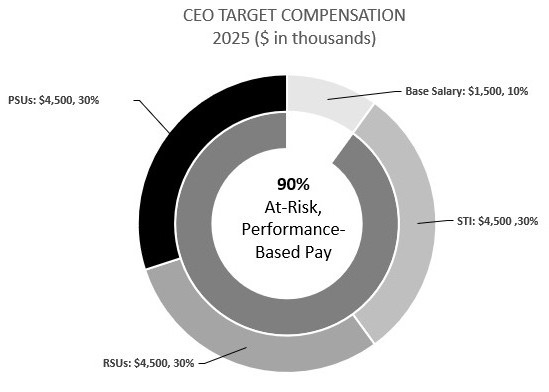
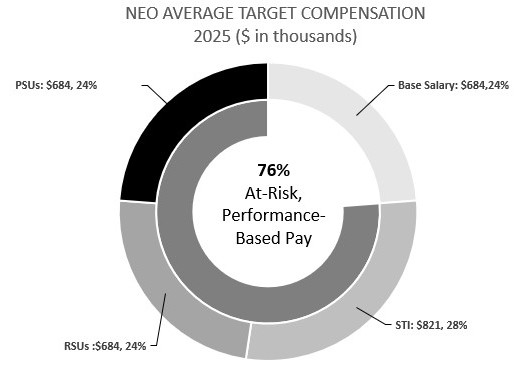
Our executive compensation program seeks to align compensation with our short-and long-term objectives, business strategy and financial performance which, in turn, aligns our Named Executive Officers’ interests with long-term stockholders’ interests. Our compensation objectives are designed to support these goals by a principles-based approach that includes:
32
COMPENSATION OBJECTIVE | PRINCIPLED APPROACH | ||||
Stakeholder Alignment | Company and individual performance goals are intended to clearly support our long-term vision and align compensation with the interests of stakeholders. We have also adopted stock ownership guidelines for our NEOs so that our executives will experience the same downside risk and upside potential as our stockholders experience. See “Stock Ownership Guidelines” above. | ||||
Competitiveness | We intend to attract and retain the highest caliber of executives and other team members. As part of this effort, we pay competitively relative to our market for talent and differentiate pay for the highest performers. | ||||
Performance-Based Awards | Through our compensation program, we strive to balance interests and drive superior Company performance. By committing to directly connecting incentive compensation with short-term corporate objectives as well as long-term growth, we seek to achieve sustained value for our stakeholders over time. | ||||
Risk Mitigation | Our compensation program supports a culture based on accountability through the use of performance metrics that are intended to be difficult, yet obtainable with hard work, and without directly or indirectly promoting irresponsible or excessive risk-taking. | ||||
Pay Equity | We believe in the power of equitable pay and are working to improve pay equity in our compensation program reviews. | ||||
Transparency | We believe in transparency for our compensation program, including its design and outcomes. | ||||
Integrity | We believe in integrity in operating our business and reporting our business results, and have adopted an executive incentive compensation recovery, or clawback, policy that complies with NYSE and SEC rules. See “Executive Incentive Compensation Recovery Policy” above. | ||||
Determination of Compensation
The Compensation Committee administers the executive compensation program relating to our executive officers in consultation with Mr. Akradi (other than with respect to his own compensation, which is reviewed and administered by the Board of Directors). The Compensation Committee assesses the performance of our executives in connection with approving any changes to executive compensation. The Compensation Committee also determines the short-term and long-term incentive programs in which our executives participate, including setting corporate goals and objectives that are consistent with our executive compensation philosophy and, in consultation with the Audit Committee, determining whether such goals and objectives were met for the year.
Role of the Board of Directors and the Compensation Committee. The Board of Directors is responsible for determining the compensation of our Founder, Chairman and Chief Executive Officer in consultation with and based on recommendations from the Compensation Committee, and the Compensation Committee oversees the executive compensation program for our other Named Executive Officers.
Role of the Compensation Consultant. The Board of Directors has engaged WTW (formerly Willis Towers Watson), an independent compensation consulting firm, since April 2021. WTW reports directly to the Compensation Committee and provides guidance regarding the amount and types of compensation that we provide to our executives, how our compensation practices compare to the compensation practices of other publicly traded companies and other compensation-related matters.
Role of Management. In setting and adjusting compensation for 2025, our Chief Executive Officer and Chief Administrative Officer worked closely with the Board of Directors and the Compensation Committee to determine appropriate levels of pay and the annual incentives and performance goals under our 2025 short-term and long-term incentive programs. Our Chief Executive Officer makes recommendations to the Board of Directors regarding compensation changes for our executive officers (other than himself) because of his daily involvement with our executive team. No executive officer participated directly in the final deliberations or determinations regarding his own compensation package.
Compensation Program Risk Assessment. Our management team and the Compensation Committee each play a role in evaluating any risk that may exist relating to our compensation plans, practices and policies for our team members, including our Named Executive Officers. In 2025, our management team, in conjunction with WTW, performed an assessment of our compensation plans, practices and policies and concluded that the Company’s compensation plans, practices and policies do not create risks that are reasonably likely to have a material adverse effect on the Company. The Compensation Committee reviewed this report and agreed with the conclusion.
33
2025 Say-on-Pay Vote. We held an advisory (non-binding) vote to approve the Company’s Named Executive Officer compensation (referred to as the “Say-on-Pay Vote”) at our 2025 annual meeting of stockholders. Over 97% of the shares voted were voted in favor of our Say-on-Pay Vote. Our Compensation Committee considered the result of this advisory vote to be an endorsement of our compensation program, policies, practices and philosophy for our Named Executive Officers. Our Compensation Committee will continue to consider the outcome of our Say-on-Pay Votes and our stockholders’ views when making compensation decisions for our Named Executive Officers.
Use of Comparative Market Data. The Compensation Committee assesses the competitiveness of each element of each executive officer’s total direct compensation against an executive pay peer group, which has been established in accordance with recommendations by WTW and provides market reference points for compensation comparison purposes. The peer group utilized by the Compensation Committee and WTW for 2025 was consistent with 2024 other than removing Cedar Fair, L.P. due to it being acquired and replacing it with Travel and Leisure Company. Our 2025 peer group consisted of the following companies:
Hilton Grand Vacations Inc. | Norwegian Cruise Line Holdings Ltd. | Travel and Leisure Company | ||||||
Hilton Worldwide Holdings Inc. | RH | Vail Resorts, Inc. | ||||||
Hyatt Hotels Corporation | Royal Caribbean Cruises Ltd. | WW International, Inc. | ||||||
Lululemon Athletica Inc. | SeaWorld Entertainment, Inc. | Wyndham Hotels & Resorts, Inc. | ||||||
Marriott Vacations Worldwide Corp. | Six Flags Entertainment Corp. | Wynn Resorts, Limited | ||||||
For 2026, WTW recommended, and the Compensation Committee approved, removing WW, International, Inc. (formerly Weight Watchers) and RH (Restoration Hardware) and adding Boyd Gaming Corporation and Red Rock Resorts, Inc. In developing this peer group, WTW considered a number of factors, including:
•Size and Complexity of the organization based on revenue and market capitalization.
•Our Market for Talent – companies from which we source and potentially lose executive talent.
•Company Characteristics such as companies with a focus on hospitality, premium lifestyle and leisure brand recognition, subscription-based revenue generation, and organizations focused on health and wellness.
The Compensation Committee does not establish compensation levels solely based on a review of competitive data. However, it believes such data is a meaningful input to the Company’s compensation policies and practices in order to motivate, attract and retain qualified executive officers. The Compensation Committee also considers a number of other factors, including Company performance relative to our stakeholder priorities, each executive’s impact and criticality to our strategy and mission, relative scope of responsibility and potential, individual performance and demonstrated leadership and internal equity pay considerations.
Elements of Our Executive Compensation Program
Our executive compensation program consists of the elements highlighted in the table below, each established to achieve the compensation objective specified below. We view each component of our executive compensation program as related but distinct, and we also regularly reassess the total compensation of our Named Executive Officers to meet our overall compensation objectives. We have determined the appropriate level for each compensation component derived in part, but not exclusively, on our understanding of the competitive market based on the experience of members of the Board of Directors and the Compensation Committee and consistent with our recruiting and retention goals, the length of service of our Named Executive Officers, our overall performance and other considerations we consider appropriate for setting compensation.
We do not currently have, and we do not expect to have, formal policies relating to the allocation of total compensation among the various elements of our compensation program.
34
COMPENSATION ELEMENT | COMPENSATION OBJECTIVES DESIGNED TO BE ACHIEVED AND KEY FEATURES | ||||
Base Salary | Attracts and retains key talent by providing base cash compensation at competitive levels | ||||
Short-Term Incentive | Provides short-term incentives based on annual performance | ||||
Long-Term Incentive | Provides long-term incentives to drive financial and operational performance and align our executives’ interests with our stockholders’ interests | ||||
Health and Welfare Benefits and Perquisites | Supports key talent through the provision of reasonable and competitive benefits | ||||
Deferred Compensation and Other Retirement Benefits | Attracts and retains key talent by providing vehicles to plan for the future | ||||
Employment and Severance Arrangements | Retains key talent through the provision of protections in the event of certain qualifying terminations or corporate events | ||||
Base Salary
The base salaries of our Named Executive Officers are an important part of their total compensation package and are intended to reflect their respective positions, duties and responsibilities. Base salary is a visible and stable fixed component of our compensation program. We evaluate the mix of base salary, short-term incentive compensation and long-term incentive compensation to appropriately align the interests of our Named Executive Officers with those of our stockholders. As such, from time-to-time, we may adjust base salaries to remain aligned with our desired positioning in the competitive marketplace and/or as we determine is in the best interests of our business and stakeholders.
For 2025, the Compensation Committee determined that no changes would be made to the base salaries of our Named Executive Officers, other than the base salary for Mr. Weaver was increased from $500,000 to $525,000 effective as of the start of 2025 to reflect his performance as the Company’s Chief Financial Officer and to address the gap in his compensation compared to other chief financial officers in the Company’s peer group.
The following table sets forth the annualized base salaries for our Named Executive Officers for fiscal year 2025:
NAMED EXECUTIVE OFFICER | FISCAL YEAR 2025 | ||||
Bahram Akradi | $1,500,000 | ||||
Erik Weaver | $525,000 | ||||
Eric Buss | $775,000 | ||||
Parham Javaheri | $810,000 | ||||
RJ Singh | $625,000 | ||||
Short-Term Incentive Compensation
We consider short-term incentive compensation to be an important component of our total compensation program and it provides incentives necessary to retain executive officers. We use short-term incentive compensation to motivate our executive officers to achieve our short-term financial and strategic objectives while making progress towards our longer-term growth and other goals. The Board of Directors and the Compensation Committee determined to issue performance-based restricted stock units in 2025 rather than pay cash under the short-term incentive plan, similar to the last two years, to continue to align the interests of our Named Executive Officers with our stockholders and for investment in the Company’s growth.
Similar to base salaries, the Compensation Committee determined that no changes would be made to the short-term incentive opportunities for our Named Executive Officers in 2025, other than to increase such opportunities for Mr. Weaver with his tranche three (maximum) opportunity increased from $400,000 to $630,000.
35
The following table sets forth the tranche three (maximum) short-term incentive opportunity for each of our Named Executive Officers for fiscal year 2025:
NAMED EXECUTIVE OFFICER | FISCAL YEAR 2025 TRANCHE THREE OPPORTUNITY | ||||
Bahram Akradi | $4,500,000 | ||||
Erik Weaver | $630,000 | ||||
Eric Buss | $930,000 | ||||
Parham Javaheri | $972,000 | ||||
RJ Singh | $750,000 | ||||
For our 2025 short-term incentive program, our Named Executive Officers were eligible to receive bonuses based on the Company’s achievement of specified Adjusted EBITDA amounts for full year 2025 (the “2025 Bonus Program”). The Compensation Committee and the Board of Directors determined that Adjusted EBITDA continued to be an appropriate metric for the 2025 Bonus Program to incentivize the Company’s growth and profitability. The Company’s leverage ratio, which was utilized in the 2024 bonus program in addition to Adjusted EBITDA, improved dramatically during 2024 and the Compensation Committee and the Board of Directors determined that metric was not required again in 2025.
Our Named Executive Officers received performance-based restricted stock units under the 2025 Bonus Program with a grant date value equal to the tranche three short-term incentive opportunity, as set forth in the table immediately above, and based on our closing stock price on the grant date of January 11, 2025, which were to vest or forfeit based on the Company’s achievement of the specified Adjusted EBITDA amounts for full year 2025.
The performance-based restricted stock units would vest at different levels, or be forfeited, based upon achievement against the tranche one performance level of $740 million, tranche two performance level of $760 million and/or tranche three performance level of $780 million of 2025 Adjusted EBITDA. The tranche one performance opportunity was set at 50% of the tranche two performance opportunity. The tranche three performance opportunity was set at 150% of the tranche two performance opportunity. Vesting under the 2025 Bonus Program was to be determined using linear interpolation if achievement fell between performance levels. If the tranche one performance level of Adjusted EBITDA were not achieved for 2025, all restricted stock units granted under the 2025 Bonus Program would have forfeited. If the tranche three performance level of Adjusted EBITDA were exceeded, participants would still only be eligible to receive vesting of their tranche three level number of performance-based restricted stock units.
We define Adjusted EBITDA as net income before interest expense, net, provision for income taxes and depreciation and amortization, excluding the impact of share-based compensation expense as well as (gain) loss on sale-leaseback transactions, capital transaction costs, legal settlements, asset impairment, severance and other items that are not indicative of the Company’s ongoing operations. See the Appendix for further information on our calculation of Adjusted EBITDA, including a reconciliation to GAAP net income.
The Compensation Committee, in coordination with the Audit Committee, determined that the Company’s Adjusted EBITDA for full year 2025 exceeded the tranche three performance level under the 2025 Bonus Program. Our $825.2 million of Adjusted EBITDA for 2025 was a 21.9% increase over our $676.8 million of Adjusted EBITDA for 2024 and represented another record year for the Company. Each Named Executive Officer therefore received full vesting at the tranche three level of his performance-based restricted stock units granted under the 2025 Bonus Program.
36
| FISCAL YEAR 2025 | |||||||||||||||||
TRANCHE ONE ($) | TRANCHE TWO ($) | TRANCHE THREE ($) | ACTUAL PAYOUT AND RESULTS | ||||||||||||||
NAMED EXECUTIVE OFFICER | ($) (1) | (#) (1) | |||||||||||||||
Short-Term Incentive Opportunity and Actual Payout | |||||||||||||||||
Bahram Akradi | 1,500,000 | 3,000,000 | 4,500,000 | 4,500,000 | 190,597 | ||||||||||||
Erik Weaver | 210,000 | 420,000 | 630,000 | 630,000 | 26,683 | ||||||||||||
Eric Buss | 310,000 | 620,000 | 930,000 | 930,000 | 39,390 | ||||||||||||
Parham Javaheri | 324,000 | 648,000 | 972,000 | 972,000 | 41,169 | ||||||||||||
RJ Singh | 250,000 | 500,000 | 750,000 | 750,000 | 31,766 | ||||||||||||
Short-Term Incentive Metric | |||||||||||||||||
Adjusted EBITDA for 2025 | 740 million | 760 million | 780 million | 825.2 million | |||||||||||||
(1) The Actual Payout represents the tranche three bonus opportunities, which were earned upon the February 25, 2026 vesting of the performance-based restricted stock units granted to each Named Executive Officer on January 11, 2025 at a closing stock price of $23.61.
In addition to the 2025 Bonus Program, the Compensation Committee awarded to Mr. Weaver a one-time cash bonus of $125,000 in recognition of his strong performance as Chief Financial Officer during 2025.
Long-Term Incentive Compensation
We view long-term incentive compensation as a critical component of our balanced total compensation program. Our long-term, equity-based compensation creates an ownership culture among our executives, provides an incentive to contribute to the continued growth and development of our business and aligns the interest of our executives with those of our stockholders. Additionally, granting equity awards emphasizes our commitment to “at risk” compensation.
For our 2025 long-term incentive program (the “2025 Long-Term Incentive Program”), we provided a combination of time-based restricted stock units and performance stock units for our Named Executive Officers under our 2021 Incentive Award Plan (the “2021 Plan”). The value of these awards under the 2025 Long-Term Incentive Program was split equally between the restricted stock units and performance stock units.
Similar to the base salaries and short-term incentive opportunities, the long-term incentive opportunities for our Named Executive Officers in 2025 remained unchanged other than the Compensation Committee approved an increase for Mr. Weaver from $331,050 to $1,050,000 to recognize his key leadership as the Chief Financial Officer, for internal equity purposes and to bring him closer to the Company’s peer group.
Approved grants of restricted stock units and performance stock units to each Named Executive Officer under the 2025 Long-Term Incentive Program were as follows:
2025 LONG-TERM INCENTIVE PROGRAM | |||||||||||
NAMED EXECUTIVE OFFICER | AGGREGATE VALUE ($) | RESTRICTED STOCK UNITS (#) | PERFORMANCE STOCK UNITS (#) | ||||||||
Bahram Akradi | 9,000,000 | 190,597 | 190,597 | ||||||||
Erik Weaver | 1,050,000 | 22,236 | 22,236 | ||||||||
Eric Buss | 1,550,000 | 32,825 | 32,825 | ||||||||
Parham Javaheri | 1,620,000 | 34,307 | 34,307 | ||||||||
RJ Singh | 1,250,000 | 26,471 | 26,471 | ||||||||
The restricted stock units vest ratably on an annual basis over three years.
37
The 2025 Long-Term Incentive Program is the second year that we have utilized multi-year performance stock unit awards since our initial public offering in 2021. Rather than granting awards that fully cliff vest after three years, our Compensation Committee again determined to issue a three-year performance stock unit award based on achieving performance levels set for Adjusted EBITDA in each of 2025, 2026 and 2027, with the value of one-third of such award determined and achieved, or “banked,” based on performance for such year; however, the award does not vest until the end of the three year period. Similar to the 2025 Bonus Program, the Compensation Committee and the Board of Directors determined to not use the Company’s leverage ratio as a performance metric for the 2025 Long-Term Incentive Program given its dramatic improvement during 2024.
For each year of the performance stock units granted under the 2025 Long-Term Incentive Program, no performance stock units will be achieved unless our Adjusted EBITDA for that year is at or above the tranche one performance level. If performance is at the tranche one performance level, 50% of the applicable performance stock units will be achieved. If performance is at the tranche two performance level, 100% of the applicable performance stock units will be achieved. If performance is at or above the tranche three performance level, 200% of the applicable performance stock units will be achieved. No more than 200% of the number of performance stock units set forth in the table above may be achieved. Achievement will be determined using linear interpolation if performance falls between performance levels. Any performance stock units that are not achieved for the applicable year shall be automatically and immediately forfeited. Our $825.2 million of Adjusted EBITDA for 2025 was greater than the tranche three performance level for 2025 and accordingly 200% of the first one-third of these performance stock units were deemed achieved and banked.
Performance stock units granted under the 2025 Long-Term Incentive Program that are achieved during each of 2025 and 2026 based on Adjusted EBITDA performance do not vest until the end of the three year period and in the event an NEO incurs a termination of service prior to the vesting date, the performance stock units will be immediately forfeited except in the event service is terminated due to death or disability, or the NEO is involuntary terminated by the Company for a reason other than cause (as defined in the award agreement), in which event such NEO will vest in the number, if any, of performance stock units that have been determined to be achieved and banked on or prior to the date of the termination of service.
With respect to the performance stock units we granted in 2024, our $825.2 million of Adjusted EBITDA for 2025 exceeded the tranche three performance level of $720 million for 2025 under the second year of the three-year performance stock unit award based on our Adjusted EBITDA, and, accordingly, 250% of the second one-third of these performance stock units were deemed achieved and banked; and our 1.6 times leverage ratio at the end of 2025 was lower than the 2.75 times performance level under the second year of the three-year performance stock unit award based on our leverage ratio for 2025 and, accordingly, the second third of that award vested in full.
We did not grant any stock options during 2025. If we were to grant stock options, our expectation is that they would be granted during the window that we typically approve our annual compensation programs for our NEOs, which is usually not at a time when we have just disclosed material nonpublic information or are about to disclose material nonpublic information.
2026 Compensation Changes
The Board of Directors and the Compensation Committee made certain changes to our compensation program for fiscal year 2026, including:
•Our 2026 short-term incentive program is again based entirely on our Adjusted EBITDA for 2026 and we issued one-year performance-based restricted stock units that will vest at a level based on our Adjusted EBITDA for 2026. We increased the short-term incentive opportunities for each of our Named Executive Officers, other than for our Chief Executive Officer, to align more closely to our peer group and to maintain a strong pay for performance culture.
•Our 2026 long-term incentive program continues to be equally split between time-based restricted stock units and performance stock units. The Compensation Committee determined to add a new external performance metric for the performance stock units granted in 2026, with the goals equally split between (1) an internal metric of Adjusted EBITDA for 2026, 2027 and 2028, with performance determined and “banked” each year but the entire award vesting at the end of the three year period and (2) a new external metric based on relative total stockholder return, measuring the Company’s three-year stock performance against the Russell 2000 Index, with cliff vesting following determination of performance in early 2029.
•Base salaries remained the same for all Named Executive Officers, except for Mr. Weaver whose base salary was increased to more closely align his overall compensation to peers in the market.
38
Health and Welfare Benefits and Perquisites
All of our full-time employees, including our Named Executive Officers, are eligible to participate in our health and welfare plans, including:
•medical, dental and vision benefits;
•medical and dependent care flexible spending accounts;
•short-term and long-term disability insurance; and
•life insurance.
These benefits are provided to our Named Executive Officers on the same general terms as they are provided to all of our full-time U.S. employees.
We also provide executive disability insurance, physicals, and family membership to our athletic country clubs to our Named Executive Officers, as well as executive physicals to certain of their significant others. Our Named Executive Officers also receive usage of a Company car or a car allowance (and maintenance), and a phone allowance. Mr. Akradi also receives a remote working, or “home connectivity,” allowance. Home connectivity for Mr. Akradi includes a high-speed network providing seamless integration of the computing and telephonic environments at Mr. Akradi’s home offices with those of our corporate headquarters. Mr. Akradi also receives the benefit of using a portion of a Company administrative assistant’s time for his personal financial and administrative matters.
In addition to the benefits described above, our Named Executive Officers received perquisites for which there was no incremental cost to us or no incremental cost attributable directly to a Named Executive Officer. These perquisites include use of Company tickets to entertainment events, minor personal travel expenses associated with travel and lodging for which the purpose of the trip was primarily business-related and de minimis use of the Company’s support staff for assistance with personal matters.
In addition, we maintain aircraft that are used primarily for business air travel by our executive officers. From time to time, Mr. Akradi may use the Company aircraft for personal air travel. Further, personal guests accompany Mr. Akradi and the other Named Executive Officers from time to time while they utilize our aircraft for business-related purposes. However, there were no incremental costs for such guest travel.
We do not view perquisites or other personal benefits as a significant component of our executive compensation program. In the future, we may provide additional perquisites or other personal benefits in limited circumstances, such as where we believe it is appropriate to assist an individual executive officer in the performance of his or her duties, to make our executive officers more efficient and effective, and for recruitment, motivation or retention purposes. All future practices with respect to perquisites or other personal benefits for our Named Executive Officers will be subject to periodic review by the Compensation Committee.
Tax Gross-Ups
Each of our Named Executive Officers receives a tax gross-up associated with the use of a Company car or car allowance provided to him. Mr. Akradi receives a tax gross-up associated with his use of Company administrative support for assistance with his personal financial and administrative matters. No other tax gross-ups are paid to the Named Executive Officers by the Company.
Deferred Compensation and Other Retirement Benefits
401(k) Plan
We currently maintain a 401(k) retirement savings plan for substantially all of our full-time employees who are at least 21 years of age, including our Named Executive Officers. Our Named Executive Officers are eligible to participate in the 401(k) plan on the same terms as other full-time employees. Under the 401(k) plan, eligible employees may elect to defer their current compensation by up to the prescribed annual limit, and contribute these amounts to the traditional 401(k) plan, or eligible employees may elect to make contributions up to the prescribed annual limit to the Roth 401(k) plan. The 401(k) plan provides for a discretionary match by the Company, which the Company determined and made in 2025 based on the lesser of 1.8% of eligible wages for 2024 (subject to IRS limitations) and 30% of the 401(k) contributions by such eligible employee in 2024.
39
We believe that providing a vehicle for tax-deferred retirement savings through our 401(k) plan adds to the overall desirability of our executive compensation package and further incentivizes our employees, including our Named Executive Officers, in accordance with our compensation policies.
Other Retirement Plans
We offer the Executive Nonqualified Excess Plan of Life Time Fitness, or Excess Plan, a non-qualified deferred compensation plan, for the benefit of employees whose projected compensation for the upcoming plan year would meet or exceed the IRS limit for determining highly compensated employees. Mr. Javaheri is the only Named Executive Officer who participated in the Excess Plan in 2025.
Employees eligible to participate in the Excess Plan, including our executives, may elect to defer up to 50% of their annual base salary and/or annual bonus earnings to be paid in any coming year. The investment choices available to participants under the non-qualified deferred compensation plan are of the same type and risk categories as those offered under our 401(k) plan and may be modified or changed by the participant or us at any time. Participants are generally eligible to receive distributions of their accounts as in-service payments or upon a separation from service. The Company may elect to make matching contributions, which vest in four ratable installments and will accelerate and vest in the event of a participant’s qualifying separation from service, including by reason of death, disability or qualifying retirement. Distributions can be paid out as a lump sum or in annual installments over a term of up to 10 years. We did not make any matching contribution to this plan during 2025. See “Nonqualified Deferred Compensation Table” for further information regarding the Excess Plan.
Employment and Severance Arrangements
We are party to offer letters and/or employment agreements with each of our Named Executive Officers other than Mr. Weaver. We entered into a new offer letter with our CEO and new employment agreements with each of our other Named Executive Officers (other than Mr. Weaver) shortly before the completion of our IPO in October 2021 consistent with Life Time’s transition to a public company. At the time of promoting Mr. Weaver to be the Company’s Executive Vice President & Chief Financial Officer effective on August 1, 2024, the Compensation Committee approved the severance that Mr. Weaver would be eligible to receive in the event of certain terminations of service. For further discussion of these arrangements, see “Named Executive Officer Employment Arrangements” below.
Tax Considerations
As a general matter, the Board of Directors and/or the Compensation Committee review and consider the various tax and accounting implications of compensation programs we utilize.
Section 409A of the Internal Revenue Code
Section 409A of the Internal Revenue Code (the “Code”) requires that “nonqualified deferred compensation” be deferred and paid under plans or arrangements that satisfy the requirements of the Code with respect to the timing of deferral elections, timing of payments and certain other matters. Failure to satisfy these requirements can expose employees and other service providers to accelerated income tax liabilities, penalty taxes and interest on their vested compensation under such plans. Accordingly, as a general matter, it is our intention to design and administer our compensation and benefits plans and arrangements for all of our employees and other service providers, including our Named Executive Officers, so that they are either exempt from, or satisfy the requirements of, Section 409A of the Code.
Section 280G of the Internal Revenue Code
Section 280G of the Code disallows a tax deduction with respect to excess parachute payments to certain executives of companies that undergo a change in control. In addition, Section 4999 of the Code imposes a 20% penalty on the individual receiving the excess payment.
Parachute payments are compensation that is linked to or triggered by a change in control and may include, but are not limited to, bonus payments, severance payments, certain fringe benefits, and payments and acceleration of vesting from long-term incentive plans including stock options and other equity-based compensation. Excess parachute payments are parachute payments that exceed a threshold determined under Section 280G of the Code based on the executive’s prior compensation. In approving the compensation arrangements for our Named Executive Officers, the Compensation Committee considers all elements of the cost to the Company of providing such compensation, including the potential impact of Section 280G of the Code. However, the Compensation Committee may, in its judgment, authorize compensation arrangements that could give rise to loss of deductibility under Section 280G of the Code and the imposition of excise taxes under Section 4999 of the Code when it believes that such arrangements are appropriate to attract and retain executive talent.
40
Section 162(m) of the Internal Revenue Code
Section 162(m) of the Code generally limits, for U.S. corporate income tax purposes, the annual tax deductibility of compensation paid to certain covered individuals, including our Named Executive Officers, to $1 million. Although the Company believes that tax deductibility of executive compensation is an important consideration, the Compensation Committee may, in its judgment, nevertheless, authorize compensation payments that are not fully tax deductible in order to achieve its compensation philosophy.
Accounting for Stock-Based Compensation
The Company accounts for stock-based compensation in accordance with the requirements of Accounting Standards Codification (“ASC”) Topic 718, “Stock Compensation.” The Company also takes into consideration ASC Topic 718 and other generally accepted accounting principles in determining changes to policies and practices for its stock-based compensation programs.
41
Compensation Committee Report
We have reviewed and discussed the Compensation Discussion and Analysis with management. Based on our review and discussion with management, the Compensation Committee recommended to the Board of Directors that the Compensation Discussion and Analysis be included in this Proxy Statement.
Compensation Committee | |||||||||||
Stuart Lasher, Chair Bahram Akradi Jonathan Coslet John Danhakl David Landau | |||||||||||
The foregoing report of the Compensation Committee does not constitute soliciting material and shall not be deemed filed, incorporated by reference into or a part of any other filing by the Company (including any future filings) under the Securities Act of 1933, as amended (the “Securities Act”) or the Exchange Act, except to the extent the Company specifically incorporates such report by reference therein.
42
Summary Compensation Table – Fiscal Years 2025, 2024 and 2023
The following table contains information about the compensation earned by each of our Named Executive Officers during our last three completed fiscal years ended December 31, 2025, 2024 and 2023, as applicable.
NAME AND PRINCIPAL POSITION | YEAR | SALARY ($) | BONUS ($) | STOCK AWARDS ($) (1) (2) (3) | OPTION AWARDS ($) (4) | NON-EQUITY INCENTIVE PLAN COMPENSATION ($) | ALL OTHER COMPENSATION ($) (7) | TOTAL ($) | ||||||||||||||||||||||||
Bahram Akradi | 2025 | 1,465,385 | — | 13,499,985 | — | — | 234,105 | 15,199,475 | ||||||||||||||||||||||||
Founder, Chairman & Chief Executive Officer | 2024 | 1,465,385 | — | 13,499,982 | — | — | 198,189 | 15,163,556 | ||||||||||||||||||||||||
2023 | 1,500,000 | — | 6,750,014 | 3,749,996 | — | 89,462 | 12,089,472 | |||||||||||||||||||||||||
Erik Weaver | 2025 | 510,289 | 125,000 | (5) | 1,679,970 | — | — | 30,956 | 2,346,215 | |||||||||||||||||||||||
Executive Vice President & Chief Financial Officer | 2024 | 405,539 | — | 517,350 | — | 400,000 | (6) | 20,065 | 1,342,954 | |||||||||||||||||||||||
Eric Buss | 2025 | 757,115 | — | 2,479,994 | — | — | 31,089 | 3,268,198 | ||||||||||||||||||||||||
Executive Vice President & Chief Administrative Officer | 2024 | 756,731 | — | 2,479,987 | — | — | 24,893 | 3,261,611 | ||||||||||||||||||||||||
2023 | 750,000 | — | 1,125,002 | 625,004 | — | 20,158 | 2,520,164 | |||||||||||||||||||||||||
Parham Javaheri | 2025 | 791,308 | — | 2,591,976 | — | — | 30,908 | 3,414,192 | ||||||||||||||||||||||||
Executive Vice President, President Club Operations & Chief Property Development Officer | 2024 | 790,385 | — | 2,592,004 | — | — | 21,712 | 3,404,101 | ||||||||||||||||||||||||
2023 | 748,558 | — | 2,143,002 | 625,004 | — | 18,141 | 3,534,705 | |||||||||||||||||||||||||
RJ Singh | 2025 | 610,577 | — | 1,999,955 | — | — | 24,425 | 2,634,957 | ||||||||||||||||||||||||
Executive Vice President & Chief Digital Officer | 2024 | 610,193 | — | 1,999,995 | — | — | 18,220 | 2,628,408 | ||||||||||||||||||||||||
(1) Amounts include for each NEO the grant-date fair value of performance-based restricted stock units granted under our short-term incentive program during fiscal 2025 based on each such NEO’s tranche three bonus opportunity as set forth in the table above under “Short-Term Incentive Compensation,” computed in accordance with ASC Topic 718 rather than the amounts paid to or realized by the named individual. The performance-based restricted stock units vested in full on February 25, 2026. We provide information regarding the assumptions used to calculate the value of all restricted stock unit awards made to executive officers in Note 11 to the consolidated financial statements included in our annual report on Form 10-K. We also paid the 2024 and 2023 short-term incentive compensation plans in restricted stock units and vested stock rather than cash.
(2) Amounts include for each NEO the grant-date fair value of restricted stock units granted under our long-term incentive program during fiscal 2025, 2024 and 2023, the grant-date fair value of restricted stock units granted to Mr. Weaver in 2024 in connection with his promotion to Executive Vice President & Chief Financial Officer, and the grant-date fair value of restricted stock units granted to Mr. Javaheri in 2023, in each case computed in accordance with ASC Topic 718 rather than the amounts paid to or realized by the named individual. We provide information regarding the assumptions used to calculate the value of all restricted stock unit awards made to executive officers in Note 11 to the consolidated financial statements included in our annual report on Form 10-K.
(3) Amounts include for each NEO the grant-date fair value of performance stock units granted under our long-term incentive program during fiscal 2025 and, other than for Mr. Weaver, 2024 based on each such NEO’s tranche two opportunity for 2025 and on each such NEO’s (other than Mr. Weaver) leverage opportunity and tranche two Adjusted EBITDA opportunity for 2024, in each case computed in accordance with ASC Topic 718 rather than the amounts paid to or realized by the named individual. The performance stock units granted in 2025 can vest up to 200% of the tranche two opportunity for each such NEO. The first third of these performance stock units were determined to have been achieved at 200%. Assuming that the grant-date fair value of these 2025 performance stock units was calculated based on each NEO’s respective tranche three (maximum) Adjusted EBITDA opportunity, the grant-date fair value of such units would have been: Mr. Akradi – $8,999,990, Mr. Weaver – $1,049,984, Mr. Buss – $1,549,997, Mr. Javaheri – $1,619,977 and Mr. Singh – $1,249,961.
The January 11, 2025 grant date stock price for the 2025 awards in each of the above footnotes was $23.61.
(4) Amounts reflect the grant-date fair value of stock options granted during fiscal 2023 computed in accordance with ASC Topic 718. We provide information regarding the assumptions used to calculate the value of all option awards made to executive officers in Note 11 to the consolidated financial statements included in our annual report on Form 10-K.
(5) Amount reflects a one-time bonus paid to Mr. Weaver in 2025.
(6) Amount reflects the actual short-term incentive award earned by Mr. Weaver in 2024. Our Adjusted EBITDA for 2024 exceeded our tranche three (maximum) performance level and our leverage ratio was below the 3.0 times performance level; accordingly on February 28, 2025, Mr. Weaver received 13,131 fully vested shares of our common stock based on a closing stock price of $30.46 on such date in accordance with ASC Topic 718.
(7) All Other Compensation for 2025 includes:
NAME | CAR ALLOWANCE / USE OF COMPANY CAR ($) | COMPANY CAR GROSS- UP ($) | PHONE ALLOWANCE ($) | PERSONAL USE OF COMPANY AIRCRAFT ($) (a) | HOME CONNECTIVITY ($) | EXECUTIVE LONG-TERM DISABILITY INSURANCE ($) | OTHER ($) (b) | TOTAL ($) | ||||||||||||||||||
Bahram Akradi | 12,000 | 10,059 | 600 | 125,948 | 6,073 | 2,220 | 77,205 | 234,105 | ||||||||||||||||||
Erik Weaver | 12,000 | 10,059 | 600 | — | — | 2,087 | 6,210 | 30,956 | ||||||||||||||||||
Eric Buss | 12,000 | 10,059 | 600 | — | — | 2,220 | 6,210 | 31,089 | ||||||||||||||||||
Parham Javaheri | 12,000 | 10,059 | 600 | — | — | 2,220 | 6,029 | 30,908 | ||||||||||||||||||
RJ Singh | 8,375 | 7,020 | 600 | — | — | 2,220 | 6,210 | 24,425 | ||||||||||||||||||
(a) We determine the incremental costs of the personal use of Company aircraft based on the variable operating costs to us, which includes (i) aircraft fuel expenses; (ii) remote hangar, landing, ramp, and airport fees; (iii) customs, foreign permit and similar fees; (iv) crew travel expenses; (v) supplies and catering; and (vi) passenger ground transportation. Flights where there are no passengers on Company aircraft (so-called “deadhead” flights) are allocated to the executive when in connection with personal use. Because Company aircraft is used primarily for business travel, this methodology excludes fixed costs that do not change based on usage, such as aircraft permanent hangar rent, insurance, depreciation and pilot salaries.
(b) Includes the costs of personal administrative support provided to Mr. Akradi of $42,000, plus the associated tax gross-up of $35,205. Also includes the Company’s matching contribution to the 401(k) plan that the Company determined and made in 2025 for each executive, other than Mr. Akradi.
43
Grants of Plan-Based Awards in Fiscal 2025
The following table provides supplemental information relating to grants of plan-based awards made during fiscal 2025 to help explain information provided above in our Summary Compensation Table. This table presents information regarding all grants of plan-based awards occurring during fiscal 2025.
NAME | GRANT DATE | ESTIMATED FUTURE PAYOUTS UNDER EQUITY INCENTIVE PLAN AWARDS | ALL OTHER STOCK AWARDS: NUMBER OF SHARES OF STOCK OR UNITS (#) | GRANT DATE FAIR VALUE OF STOCK AND OPTION AWARDS ($) (4) | ||||||||||||||||||||||||||||
THRESHOLD (#) | TARGET (#) | MAXIMUM (#) | ||||||||||||||||||||||||||||||
Bahram Akradi | 1/11/2025 | 63,532 | (1) | 127,064 | (1) | 190,597 | (1) | — | 4,499,995 | |||||||||||||||||||||||
1/11/2025 | — | — | — | 190,597 | (2) | 4,499,995 | ||||||||||||||||||||||||||
1/11/2025 | 95,298 | (3) | 190,597 | (3) | 381,194 | (3) | — | 4,499,995 | ||||||||||||||||||||||||
Erik Weaver | 1/11/2025 | 8,894 | (1) | 17,789 | (1) | 26,683 | (1) | — | 629,986 | |||||||||||||||||||||||
1/11/2025 | — | — | — | 22,236 | (2) | 524,992 | ||||||||||||||||||||||||||
1/11/2025 | 11,118 | (3) | 22,236 | (3) | 44,472 | (3) | — | 524,992 | ||||||||||||||||||||||||
Eric Buss | 1/11/2025 | 13,130 | (1) | 26,260 | (1) | 39,390 | (1) | — | 929,998 | |||||||||||||||||||||||
1/11/2025 | — | — | — | 32,825 | (2) | 774,998 | ||||||||||||||||||||||||||
1/11/2025 | 16,412 | (3) | 32,825 | (3) | 65,650 | (3) | — | 774,998 | ||||||||||||||||||||||||
Parham Javaheri | 1/11/2025 | 13,723 | (1) | 27,446 | (1) | 41,169 | (1) | — | 972,000 | |||||||||||||||||||||||
1/11/2025 | — | — | — | 34,307 | (2) | 809,988 | ||||||||||||||||||||||||||
1/11/2025 | 17,153 | (3) | 34,307 | (3) | 68,614 | (3) | — | 809,988 | ||||||||||||||||||||||||
RJ Singh | 1/11/2025 | 10,588 | (1) | 21,177 | (1) | 31,766 | (1) | — | 749,995 | |||||||||||||||||||||||
1/11/2025 | — | — | — | 26,471 | (2) | 624,980 | ||||||||||||||||||||||||||
1/11/2025 | 13,235 | (3) | 26,471 | (3) | 52,942 | (3) | — | 624,980 | ||||||||||||||||||||||||
(1) These awards represent the number of performance-based restricted stock units with a one-year performance period that were granted at maximum (tranche three) under our 2025 Bonus Program under the 2021 Plan, as described in “Short-Term Incentive Compensation” above. These restricted stock unit awards were subject to Adjusted EBITDA performance conditions. Our Adjusted EBITDA exceeded the tranche three performance level and, accordingly, these performance-based restricted stock units vested in full on February 25, 2026.
(2) These awards represent the number of time-based restricted stock units that were granted as part of our 2025 Long-Term Incentive Program under the 2021 Plan. These restricted stock unit awards vest ratably on an annual basis over three years beginning on February 1, 2026.
(3) These awards represent the number of performance stock units that were granted at target (tranche two) under our 2025 Long-Term Incentive Program under the 2021 Plan, as described in “Long-Term Incentive Compensation” above. These performance stock unit awards are subject to performance conditions based on our Adjusted EBITDA for 2025, 2026 and 2027. The performance stock units can be achieved up to 200% of the target amount and vest following determination of our performance for 2027. Our Adjusted EBITDA for 2025 exceeded the tranche three performance level and, accordingly, achieved at 200% of the target amount for 2025.
(4) The amount shown with respect to each award represents the grant date fair value of the award calculated using the assumptions described in Note 11 to the consolidated financial statements included in our annual report on Form 10-K.
NARRATIVE TO SUMMARY COMPENSATION TABLE AND GRANTS OF PLAN-BASED AWARDS TABLE
Named Executive Officer Employment Arrangements
In connection with our IPO in October 2021, the Company entered into a new offer letter with Mr. Akradi and new employment agreements with each of our other Named Executive Officers other than Mr. Weaver. In connection with the promotion of Mr. Weaver as the Company’s Executive Vice President and Chief Financial Officer effective August 1, 2024, the Compensation Committee agreed to certain employment terms for Mr. Weaver. The principal elements of each such offer letter and employment agreement or arrangements with each of our Named Executive Officers are summarized below.
Bahram Akradi
Effective as of August 18, 2021, Mr. Akradi entered into an offer letter with the Company, which provided for Mr. Akradi’s continued employment as Chief Executive Officer and Chairman of the Board of Directors (the “CEO Offer Letter”). Pursuant to the CEO Offer Letter, commencing as of fiscal year 2022, Mr. Akradi is entitled to a base salary of $1,500,000, an annual performance bonus ranging from 0% to 300% of his base salary and annual equity grants with a target or tranche two grant date value of at least $7,500,000 for fiscal years 2022 to 2024, subject to the discretion of the Board of Directors or Compensation Committee. In addition, the CEO Offer Letter provides that Mr. Akradi was eligible to receive an IPO equity grant comprised of
44
50% stock options and 50% restricted stock units with a target grant date value of at least $5,000,000. Notwithstanding the foregoing, Mr. Akradi elected to voluntarily forego the receipt of such IPO equity grant.
Mr. Akradi was not entitled to severance payments or benefits under the CEO Offer Letter in connection with any termination of employment on or prior to August 18, 2024. In the event that Mr. Akradi’s employment is terminated by the Company without Cause or by Mr. Akradi for Good Reason following August 18, 2024, then, subject to Mr. Akradi’s execution of a release of claims and continued compliance with applicable restrictive covenants, he will be entitled to receive severance benefits that are at least as favorable as those generally provided to other senior executives of the Company as of the date of such termination. Furthermore, the CEO Offer Letter provides for a Section 280G “best net” cutback pursuant to which if payments or benefits received by Mr. Akradi in connection with a change in control constitute Section 280G excess parachute payments subject to the associated excise tax, the amount of payments received by him will be reduced to the extent such reduction would result in Mr. Akradi receiving a larger after-tax amount than if he received the full amount of the payments subject to the excise tax.
In connection with the CEO Offer Letter, Mr. Akradi also entered into an Employee Non-Competition Agreement (the “NCA”). Pursuant to the NCA, Mr. Akradi is subject to perpetual confidentiality and mutual non-disparagement covenants, and non-competition and non-solicit covenants through the 24-month anniversary of Mr. Akradi’s termination of employment with the Company.
As an inducement for Mr. Akradi to enter the NCA and the CEO Offer Letter (including his agreement to forego the right to receive any severance benefits for the three-year period following the effectiveness of the CEO Offer Letter), we agreed to extinguish the loan under the loan agreement entered into by Mr. Akradi with us.
For purposes of the CEO Offer Letter, “Cause” means (a) commission of an act of material fraud or material dishonesty against the Company or any of its subsidiaries; (b) intentional refusal or willful failure to substantially carry out the lawful and reasonable instructions of the Board of Directors after receiving written notification of the failure from the Board of Directors (other than any such failure resulting from Mr. Akradi’s disability and excluding any failure to achieve a lawful and reasonable directive following the expenditure by Mr. Akradi of commercially reasonable best efforts); (c) commission of, indictment for, conviction of, guilty plea or “no contest” plea to a felony or to a misdemeanor involving moral turpitude (where moral turpitude means so extreme a departure from ordinary standards of honesty, good morals, justice or ethics as to be shocking to the moral sense of the community); (d) gross misconduct in connection with the performance of Mr. Akradi’s duties; (e) improper disclosure of confidential information, which use or disclosure causes or could reasonably be expected to cause material harm to the Company or any of its subsidiaries; (f) failure to reasonably cooperate with the Company or any of its subsidiaries in any investigation or formal proceeding; or (g) Mr. Akradi’s material breach of the CEO Offer Letter, the NCA or any other written agreement or arrangement with the Company or any of its subsidiaries, provided that the foregoing shall not constitute Cause unless the Company first gives written notice to Mr. Akradi 30 days prior to termination for Cause, delineating the claimed breach and setting forth the Company’s intention to terminate his employment if such breach is not duly remedied within 30 business days, and Mr. Akradi fails to cure the condition within such 30-day period.
For purposes of the CEO Offer Letter, “Good Reason” means Mr. Akradi’s resignation following the occurrence, without his express, written consent, of one or more of the following conditions (whether by a single action or a series of actions): (a) a material reduction by the Company in Mr. Akradi’s title, duties, responsibilities, or authority as Chief Executive Officer of the Company; (b) a material reduction by the Company of Mr. Akradi’s annual base salary or target bonus, other than as part of a reduction affecting all or substantially all of the Company’s senior leadership team; or (c) the Company’s material breach of the CEO Offer Letter, provided that the foregoing shall not constitute Good Reason unless Mr. Akradi provides written notice to the Company of the event or condition giving rise to Good Reason within 30 days after its initial occurrence, such event or condition continues to exist on the 30th day following his provision of such notice to the Company and Mr. Akradi’s resignation is effective within 30 days following the end of such period.
Executive Employment Agreements and Arrangements
In connection with the IPO, the Company entered into new employment agreements with Messrs. Buss, Javaheri and Singh, effective as of October 12, 2021 (the “Executive Employment Agreements”), and in connection with his promotion to Executive Vice President and Chief Financial Officer, the Compensation Committee approved certain employment arrangements for Mr. Weaver, effective as of August 1, 2024. The Executive Employment Agreements provide for a three-year initial term of employment with successive one-year automatic extensions of the term, provided that either party does not provide prior written notice of non-extension of the term.
Under the Executive Employment Agreements, the Company has certain obligations that become due in the event of termination. If the executive’s employment is terminated by the Company other than for Cause (as defined below, and excluding death or disability) or by the executive for Good Reason (as defined below), then in addition to any accrued amounts, subject to
45
such executive’s execution and non-revocation of a release of claims, such executive would be eligible to receive (i) a severance payment equal to one-half times the sum of (a) his annual base salary and (b) his target annual cash bonus for the year in which termination occurs, subject to certain limitations on the amount as set forth in the Executive Employment Agreement, payable in substantially equal installments in accordance with the Company’s regular payroll practices over the six-month period following termination; provided, that if the severance payment is reduced pursuant to the terms of the Executive Employment Agreement, such executive would be entitled to an additional lump sum severance payment equal to the amount of the reduction of such severance payment; (ii) an amount equal to the sum of (a) his annual base salary and (b) his target annual cash bonus for the year in which termination occurs, payable over the 12-month period commencing after the completion of any installment payments pursuant to clause (i) in substantially equal installments in accordance with the Company’s regular payroll practices; and (iii) continued COBRA coverage for up to 18 months. Additionally, upon a termination due to death or disability, in addition to the accrued amounts, such executive is eligible to receive, subject to the execution and non-revocation of a release of claims, the annual cash bonus he would have been entitled to receive had he remained employed until the end of the fiscal year (prorated for the period of active employment during the fiscal year). Similarly, if Mr. Weaver’s employment is terminated by the Company other than for Cause (as defined below) or by him for Good Reason (as defined below), Mr. Weaver would be entitled to receive the sum of (a) his annual base salary and (b) his tranche three (maximum) annual cash bonus for the year in which termination occurs.
The Executive Employment Agreements also provide for a Section 280G “best net” cutback and the executives are each subject to perpetual confidentiality and mutual non-disparagement covenants, and non-competition and non-solicit covenants through the 24-month anniversary of his termination of employment with the Company.
For purposes of each Executive Employment Agreement and Mr. Weaver’s severance arrangements, “Cause” means (i) repeated and willful or grossly negligent failure to perform the executive’s material duties on behalf of the Company; (ii) the executive’s willful or grossly negligent violation of any material Company rule, procedure or policy, or breach of any non-disclosure, non-competition, non-solicitation or other similar agreement between the Company (or any subsidiaries thereof) and the executive; (iii) the executive’s plea of nolo contendere to, or conviction of a felony, a crime of moral turpitude or a misdemeanor involving fraud or dishonesty (other than minor traffic violations or similar offenses) or that could reasonably be expected to result in material harm, whether business, financial, reputational or otherwise, to the Company or its subsidiaries; (iv) the perpetration of any act of fraud, embezzlement or material dishonesty against or affecting the Company, any of its subsidiaries, or any customer, agent or employee thereof; (v) material breach of fiduciary duty or material breach of the Executive Employment Agreement (or any other written agreement by and between the executive and the Company) by executive; (vi) repeated insolent or abusive conduct in the workplace, including but not limited to, harassment of others of a racial or sexual nature; or (vii) engaging in any act of material self-dealing without prior notice to and consent by the Board of Directors, provided that the foregoing shall not constitute Cause unless the executive fails to cure the circumstances constituting Cause within 30 days after written notice.
In the event of the executive’s arrest or indictment for a felony, crime or misdemeanor as described in the applicable provision of the Executive Employment Agreement, the Company shall have the right (but not the obligation) to suspend the executive without pay until either (a) a court of competent jurisdiction makes a final determination of the executive’s guilt or innocence or (b) the executive pleads nolo contendere to such alleged felony or crime; provided that if the court makes a final determination that the executive should be acquitted of such felony or crime, the Company shall either reinstate the executive and repay to him such withheld base salary or terminate his employment without Cause.
For purposes of each Executive Employment Agreement and Mr. Weaver’s severance arrangements, “Disability” means the executive’s inability to perform on a full-time basis the duties and responsibilities of executive’s employment with the Company by reason of executive’s illness or other physical or mental impairment or condition, as determined by a physician mutually acceptable to executive and the Company, if such inability continues for an uninterrupted period of 90 days or more during any 365-day period. A period of inability shall be “uninterrupted” unless and until executive returns to full-time work from the above-referenced leave for a continuous period of at least 180 days, excluding vacation days or sick days taken for reasons unrelated to the illness or other physical or mental impairment or condition necessitating the above-referenced leave.
For purposes of each Executive Employment Agreement and Mr. Weaver’s severance arrangements, “Good Reason” means (i) the Company has breached any material term(s) or material condition(s) of the Executive Employment Agreement or Mr. Weaver’s employment arrangements; (ii) a requirement imposed by the Company on the executive that executive’s principal place of employment be anywhere other than within a 75-mile radius of the executive’s principal location, and the relocation results in a material change to the geographic location at which the executive performs services; (iii) a material reduction in the executive’s base salary or target bonus as then in effect, other than in connection with an across-the-board reduction affecting other similarly situated executives of the Company; or (iv) the Company has assigned duties and responsibilities to executive that are materially inconsistent with executive’s position, duties or responsibilities as set forth in the Executive Employment Agreement, such that there occurs a material reduction in executive’s duties, responsibilities or authority as set forth in the Executive Employment Agreement.
46
Equity Awards
Outstanding stock options granted prior to 2021 pursuant to the 2015 Equity Incentive Plan to the Named Executive Officers all vested prior to or in connection with the IPO and became exercisable on April 4, 2022, other than with respect to Mr. Akradi whose stock options became exercisable effective upon the IPO.
Stock options granted in 2021 pursuant to the 2015 Equity Incentive Plan prior to the IPO do not accelerate vesting upon a change in control or a termination of employment for any reason. However, the Compensation Committee may exercise discretion to accelerate vesting of awards or allow awards to continue to vest post-termination.
Stock options and restricted stock unit awards granted to the Named Executive Officers under the 2021 Plan provide that if the executive’s employment is terminated without “cause” within 12 months after a change in control, all awards will be fully vested. Otherwise, vesting will not accelerate upon a change in control or for any other termination of employment; however, the Compensation Committee may exercise discretion to accelerate vesting of awards or allow awards to continue to vest post-termination.
Upon death, disability or termination without cause, performance stock units will vest according to actual achievement for any completed performance period.
47
Outstanding Equity Awards at Fiscal Year-End Table
The following table summarizes the number of shares of common stock underlying outstanding equity incentive plan awards for each Named Executive Officer as of December 31, 2025.
OPTION AWARDS | STOCK AWARDS | ||||||||||||||||||||||||||||||||||||||||
NAME | GRANT DATE | NUMBER OF SECURITIES UNDERLYING UNEXERCISED OPTIONS (#) EXERCISABLE | NUMBER OF SECURITIES UNDERLYING UNEXERCISED OPTIONS (#) UNEXERCISABLE | OPTION EXERCISE PRICE ($) | OPTION EXPIRATION DATE | NUMBER OF SHARES OR UNITS OF STOCK THAT HAVE NOT VESTED (#) | MARKET VALUE OF SHARES OR UNITS OF STOCK THAT HAVE NOT VESTED ($) (1) | EQUITY INCENTIVE PLAN AWARDS: NUMBER OF UNEARNED SHARES, UNITS OR OTHER RIGHTS THAT HAVE NOT VESTED (#) | EQUITY INCENTIVE PLAN AWARDS: MARKET OR PAYOUT VALUE OF UNEARNED SHARES, UNITS OR OTHER RIGHTS THAT HAVE NOT VESTED ($) (1) | ||||||||||||||||||||||||||||||||
Bahram Akradi | 3/17/2022 | 381,098 | (2) | 127,032 | (2) | 13.65 | 3/17/2032 | — | — | — | — | ||||||||||||||||||||||||||||||
3/9/2023 | 196,130 | (3) | 196,129 | (3) | 17.27 | 3/9/2033 | — | — | — | — | |||||||||||||||||||||||||||||||
3/9/2023 | — | — | — | — | 108,570 | (4) | 2,885,791 | — | — | ||||||||||||||||||||||||||||||||
2/7/2024 | — | — | — | — | 225,903 | (5) | 6,004,502 | — | — | ||||||||||||||||||||||||||||||||
2/7/2024 | — | — | — | — | — | — | 75,300 | (6) | 2,001,474 | ||||||||||||||||||||||||||||||||
2/7/2024 | — | — | — | — | 188,255 | (7) | 5,003,818 | 150,602 | (7) | 4,003,001 | |||||||||||||||||||||||||||||||
1/11/2025 | — | — | — | — | — | — | 190,597 | (8) | 5,066,068 | ||||||||||||||||||||||||||||||||
1/11/2025 | — | — | — | — | 190,597 | (9) | 5,066,068 | — | — | ||||||||||||||||||||||||||||||||
1/11/2025 | — | — | — | — | — | — | 190,597 | (10) | 5,066,068 | ||||||||||||||||||||||||||||||||
Erik Weaver | 5/3/2021 | 15,000 | (11) | — | 19.32 | 5/3/2031 | — | — | — | — | |||||||||||||||||||||||||||||||
5/31/2022 | — | — | — | — | 2,777 | (12) | 73,813 | — | — | ||||||||||||||||||||||||||||||||
10/12/2022 | — | — | — | — | 12,500 | (13) | 332,250 | — | — | ||||||||||||||||||||||||||||||||
4/24/2023 | 5,000 | (14) | 5,000 | (14) | 17.59 | 4/24/2033 | — | — | — | — | |||||||||||||||||||||||||||||||
2/27/2024 | — | — | — | — | 10,000 | (15) | 265,800 | — | — | ||||||||||||||||||||||||||||||||
8/1/2024 | — | — | — | — | 15,000 | (16) | 398,700 | — | — | ||||||||||||||||||||||||||||||||
1/11/2025 | — | — | — | — | — | — | 26,683 | (8) | 709,234 | ||||||||||||||||||||||||||||||||
1/11/2025 | — | — | — | — | 22,236 | (9) | 591,033 | — | — | ||||||||||||||||||||||||||||||||
1/11/2025 | — | — | — | — | — | — | 22,236 | (10) | 591,033 | ||||||||||||||||||||||||||||||||
Eric Buss | 6/8/2016 | 512,791 | (17) | — | 10.00 | 6/8/2026 | — | — | — | — | |||||||||||||||||||||||||||||||
5/3/2021 | 260,000 | (18) | — | 19.32 | 5/3/2031 | — | — | — | — | ||||||||||||||||||||||||||||||||
10/6/2021 | 85,519 | (19) | — | 18.00 | 10/6/2031 | — | — | — | — | ||||||||||||||||||||||||||||||||
3/17/2022 | 63,516 | (2) | 21,172 | (2) | 13.65 | 3/17/2032 | — | — | — | — | |||||||||||||||||||||||||||||||
3/9/2023 | 32,689 | (3) | 32,688 | (3) | 17.27 | 3/9/2033 | — | — | — | — | |||||||||||||||||||||||||||||||
3/9/2023 | — | — | — | — | 18,094 | (4) | 480,939 | — | — | ||||||||||||||||||||||||||||||||
2/7/2024 | — | — | — | — | 38,905 | (5) | 1,034,095 | — | — | ||||||||||||||||||||||||||||||||
2/7/2024 | — | — | — | — | — | — | 12,968 | (6) | 344,689 | ||||||||||||||||||||||||||||||||
2/7/2024 | — | — | — | — | 32,420 | (7) | 861,724 | 25,937 | (7) | 689,405 | |||||||||||||||||||||||||||||||
1/11/2025 | — | — | — | — | — | — | 39,390 | (8) | 1,046,986 | ||||||||||||||||||||||||||||||||
1/11/2025 | — | — | — | — | 32,825 | (9) | 872,489 | — | — | ||||||||||||||||||||||||||||||||
1/11/2025 | — | — | — | — | — | — | 32,825 | (10) | 872,489 | ||||||||||||||||||||||||||||||||
Parham Javaheri | 7/2/2018 | 90,000 | (17) | — | 14.26 | 7/2/2028 | — | — | — | — | |||||||||||||||||||||||||||||||
3/27/2019 | 100,000 | (17) | — | 17.95 | 3/27/2029 | — | — | — | — | ||||||||||||||||||||||||||||||||
5/3/2021 | 176,000 | (18) | — | 19.32 | 5/3/2031 | — | — | — | — | ||||||||||||||||||||||||||||||||
10/6/2021 | 76,967 | (19) | — | 18.00 | 10/6/2031 | — | — | — | — | ||||||||||||||||||||||||||||||||
3/11/2022 | — | — | — | — | 12,500 | (20) | 332,250 | — | — | ||||||||||||||||||||||||||||||||
3/17/2022 | 57,165 | (2) | 19,055 | (2) | 13.65 | 3/17/2032 | — | — | — | — | |||||||||||||||||||||||||||||||
3/9/2023 | 32,689 | (3) | 32,688 | (3) | 17.27 | 3/9/2033 | — | — | — | — | |||||||||||||||||||||||||||||||
3/9/2023 | — | — | — | — | 18,094 | (4) | 480,939 | — | — | ||||||||||||||||||||||||||||||||
5/12/2023 | — | — | — | — | 25,000 | (21) | 664,500 | — | — | ||||||||||||||||||||||||||||||||
2/7/2024 | — | — | — | — | 40,662 | (5) | 1,080,796 | — | — | ||||||||||||||||||||||||||||||||
2/7/2024 | — | — | — | — | — | — | 13,554 | (6) | 360,265 | ||||||||||||||||||||||||||||||||
2/7/2024 | — | — | — | — | 33,885 | (7) | 900,663 | 27,108 | (7) | 720,531 | |||||||||||||||||||||||||||||||
1/11/2025 | — | — | — | — | — | — | 41,169 | (8) | 1,094,272 | ||||||||||||||||||||||||||||||||
1/11/2025 | — | — | — | — | 34,307 | (9) | 911,880 | — | — | ||||||||||||||||||||||||||||||||
1/11/2025 | — | — | — | — | — | — | 34,307 | (10) | 911,880 | ||||||||||||||||||||||||||||||||
48
OPTION AWARDS | STOCK AWARDS | ||||||||||||||||||||||||||||||||||||||||
NAME | GRANT DATE | NUMBER OF SECURITIES UNDERLYING UNEXERCISED OPTIONS (#) EXERCISABLE | NUMBER OF SECURITIES UNDERLYING UNEXERCISED OPTIONS (#) UNEXERCISABLE | OPTION EXERCISE PRICE ($) | OPTION EXPIRATION DATE | NUMBER OF SHARES OR UNITS OF STOCK THAT HAVE NOT VESTED (#) | MARKET VALUE OF SHARES OR UNITS OF STOCK THAT HAVE NOT VESTED ($) (1) | EQUITY INCENTIVE PLAN AWARDS: NUMBER OF UNEARNED SHARES, UNITS OR OTHER RIGHTS THAT HAVE NOT VESTED (#) | EQUITY INCENTIVE PLAN AWARDS: MARKET OR PAYOUT VALUE OF UNEARNED SHARES, UNITS OR OTHER RIGHTS THAT HAVE NOT VESTED ($) (1) | ||||||||||||||||||||||||||||||||
RJ Singh | 2/19/2020 | 170,000 | (17) | — | 25.00 | 2/19/2030 | — | — | — | — | |||||||||||||||||||||||||||||||
5/3/2021 | 132,000 | (18) | — | 19.32 | 5/3/2031 | — | — | — | — | ||||||||||||||||||||||||||||||||
10/6/2021 | 68,415 | (19) | — | 18.00 | 10/6/2031 | — | — | — | — | ||||||||||||||||||||||||||||||||
3/17/2022 | 50,814 | (2) | 16,937 | (2) | 13.65 | 3/17/2032 | — | — | — | — | |||||||||||||||||||||||||||||||
3/9/2023 | 26,151 | (3) | 26,150 | (3) | 17.27 | 3/9/2033 | — | — | — | — | |||||||||||||||||||||||||||||||
3/9/2023 | — | — | — | — | 14,476 | (4) | 384,772 | — | — | ||||||||||||||||||||||||||||||||
5/12/2023 | — | — | — | — | 12,500 | (21) | 332,250 | — | — | ||||||||||||||||||||||||||||||||
2/7/2024 | — | — | — | — | 31,375 | (5) | 833,948 | — | — | ||||||||||||||||||||||||||||||||
2/7/2024 | — | — | — | — | — | — | 10,458 | (6) | 277,974 | ||||||||||||||||||||||||||||||||
2/7/2024 | — | — | — | — | 26,145 | (7) | 694,934 | 20,917 | (7) | 555,974 | |||||||||||||||||||||||||||||||
1/11/2025 | — | — | — | — | — | — | 31,766 | (8) | 844,340 | ||||||||||||||||||||||||||||||||
1/11/2025 | — | — | — | — | 26,471 | (9) | 703,599 | — | — | ||||||||||||||||||||||||||||||||
1/11/2025 | — | — | — | — | — | — | 26,471 | (10) | 703,599 | ||||||||||||||||||||||||||||||||
(1) Market value reflects the number of unvested restricted stock units or unvested performance stock units at tranche two (target), or at the amount determined to be “banked” for any completed performance period, multiplied by $26.58 per share, the closing price of our common stock on the NYSE on December 31, 2025, the last trading day of fiscal 2025.
(2) Each such option award vests ratably on an annual basis over four years beginning on March 17, 2023.
(3) Each such option award vests ratably on an annual basis over four years beginning on March 9, 2024.
(4) Each such restricted stock unit vests ratably on an annual basis over the remaining two years (of a four-year award) on February 28, 2026 and 2027.
(5) Each such restricted stock unit vests ratably on an annual basis over the remaining two years (of a three-year award) on February 28, 2026 and 2027.
(6) Each such three-year performance stock unit vests over the remaining two performance periods (one-half for each of 2025 and 2026) on the later of our determination of our performance under the performance stock units for each of 2025 and 2026 and the first full trading date following the release of our financial results for each of 2025 and 2026, subject to satisfying a performance condition for each of 2025 and 2026 such that one-half of the performance stock units are to be forfeited in whole if our leverage ratio at the end of 2025 or 2026, as applicable, is not at or below the required leverage ratio for such year. Our leverage ratio was below the required 2.75 times for 2025 and, accordingly, one-half of the performance stock units vested in full on February 25, 2026. Similarly, our leverage ratio was below the required 3.0 times for 2024 and, accordingly, one-third of the performance stock units vested in full on February 28, 2025 (and are therefore not reflected in the table).
(7) Each such three-year performance stock unit vests on the later of our determination of our performance under the performance stock units for 2026 and the first full trading date following the release of our financial results for 2026, subject to satisfying a performance condition for each of 2024, 2025 and 2026 such that one-third of the performance stock units can be achieved or forfeited in whole or in part based on our Adjusted EBITDA for 2024, 2025 and 2026. Our Adjusted EBITDA for 2024 exceeded the tranche three performance level and, accordingly, achieved at 250% of the target amount for 2024 and are now reflected in the table at the maximum number of shares that have not yet vested. The performance stock units for the 2025 and 2026 performance periods are shown at target but can also be achieved up to 250% of the target amount each year. Our Adjusted EBITDA for 2025 exceeded the tranche three performance level and, accordingly, achieved at 250% of the target amount for 2025.
(8) Each such performance-based restricted stock unit was to vest on the later of our determination of our performance under the 2025 Bonus Program and the first full trading date following the release of our 2025 financial results, subject to satisfying a performance condition such that they were to be forfeited in whole or in part if our Adjusted EBITDA for 2025 did not equal or exceed $780 million. Our Adjusted EBITDA for 2025 exceeded such amount and, accordingly, these performance-based restricted stock units vested in full on February 25, 2026.
(9) Each such restricted stock unit vests ratably on an annual basis over three years on February 1, 2026, 2027 and 2028.
(10) Each such three-year performance stock unit vests on the later of our determination of our performance under the performance stock units for 2027 and the first full trading date following the release of our financial results for 2027, subject to satisfying a performance condition for each of 2025, 2026 and 2027 such that one-third of the performance stock units can be achieved or forfeited in whole or in part based on our Adjusted EBITDA for 2025, 2026 and 2027. The performance stock units are shown at target but can be achieved up to 200% of the target amount each year. Our Adjusted EBITDA for 2025 exceeded the tranche three performance level and, accordingly, achieved at 200% of the target amount for 2025.
(11) Such option award is now fully vested after vesting ratably on an annual basis over four years beginning on May 1, 2022.
(12) Such restricted stock unit vests on March 1, 2026 for the remaining one year of a four-year award.
(13) Such restricted stock unit vests on October 12, 2026 for the remaining one year of a four-year award.
(14) Such option award vests ratably on an annual basis over four years beginning on March 1, 2024.
(15) Such restricted stock unit vests ratably on an annual basis over the remaining two years (of a three-year award) on February 1, 2026 and 2027.
(16) Such restricted stock unit cliff vests on August 1, 2027.
(17) Each such option award vested in full prior to or upon the IPO in October 2021, as applicable, and became exercisable on April 4, 2022.
(18) Each such option award is now fully vested after vesting (i) 50% on March 8, 2022, based on performance conditions for 2021 that were deemed met and became exercisable on April 4, 2022 and (ii) 50% ratably on an annual basis over four years beginning on May 1, 2022.
(19) Each such option award is now fully vested after vesting ratably on an annual basis over four years beginning on October 6, 2022.
(20) Such restricted stock unit vests on March 11, 2026 for the remaining one year of a four-year award.
(21) Each such restricted stock unit vests ratably on an annual basis over the remaining two years (of a four-year award) on May 1, 2026 and 2027.
49
Option Exercises and Stock Vested Table
The following table summarizes the number of shares of common stock on an aggregated basis acquired on exercise of stock options and vesting of underlying awards of stock, including restricted stock units and performance stock units, for each Named Executive Officer during the fiscal year ended December 31, 2025.
OPTION AWARDS | STOCK AWARDS | |||||||||||||
NAME | NUMBER OF SHARES ACQUIRED ON EXERCISE (#) | VALUE REALIZED ON EXERCISE ($) | NUMBER OF SHARES ACQUIRED ON VESTING (#) | VALUE REALIZED ON VESTING ($) | ||||||||||
Bahram Akradi | 9,388,000 | 199,964,400 | 543,743 | 16,562,412 | ||||||||||
Erik Weaver | — | — | 23,055 | 617,451 | ||||||||||
Eric Buss | 237,209 | 4,247,531 | 115,431 | 3,463,219 | ||||||||||
Parham Javaheri | — | — | 146,850 | 4,388,895 | ||||||||||
RJ Singh | 80,000 | 1,401,600 | 113,103 | 3,335,202 | ||||||||||
Nonqualified Deferred Compensation Table
We maintain the Excess Plan for a select group of eligible highly compensated employees, including all of our Named Executive Officers. The terms of the Excess Plan are described in the CD&A. The following table contains information regarding our executives’ participation in our nonqualified deferred compensation plan.
NAME | EXECUTIVE CONTRIBUTIONS IN LAST FY ($) | REGISTRANT CONTRIBUTIONS IN LAST FY ($) | AGGREGATE EARNINGS IN LAST FY ($) (1) (2) | AGGREGATE WITHDRAWALS/ DISTRIBUTIONS ($) | AGGREGATE BALANCE AT LAST FYE ($) | |||||||||||||||
Bahram Akradi | — | — | — | — | — | |||||||||||||||
Erik Weaver | — | — | — | — | — | |||||||||||||||
Eric Buss | — | — | — | — | — | |||||||||||||||
Parham Javaheri | 161,533 | — | 93,094 | — | 648,847 | (3) | ||||||||||||||
RJ Singh | — | — | — | — | — | |||||||||||||||
(1) Reflects the aggregate interest or other earnings accrued during the last fiscal year.
(2) These amounts do not represent above-market earnings, and thus are not reported in the Summary Compensation Table.
(3) Mr. Javaheri began his participation in the Excess Plan in 2023 and elected in-service distributions in a future calendar year.
50
Potential Payments Upon Termination or Change in Control
In this section, we describe payments that may be made to our Named Executive Officers upon several events of termination, assuming the termination event occurred on the last day of fiscal 2025 (except as otherwise noted). This section does not cover all amounts our Named Executive Officers will receive following termination, such as the receipt of vested benefits. The following table shows the payments and benefits for which the amount, vesting or time of payment is altered by each employment termination situation.
As of December 31, 2025, we had entered into employment agreements or other approved arrangements with each of our Named Executive Officers that provide for potential payments upon a qualifying termination of employment. For additional information on such arrangements, see “Narrative to Summary Compensation Table and Grants of Plan-Based Awards Table—Named Executive Officer Employment Arrangements.” In addition, pursuant to the applicable equity arrangements, our Named Executive Officers are entitled to receive acceleration of vesting or continued vesting of certain of their outstanding awards upon the occurrence of certain qualifying events. (1)
NAME | BENEFIT | TERMINATION WITHOUT CAUSE OR FOR GOOD REASON (NO CHANGE IN CONTROL) ($) | CHANGE IN CONTROL (NO TERMINATION) ($) (2) | TERMINATION WITHOUT CAUSE OR FOR GOOD REASON (IN CONNECTION WITH A CHANGE IN CONTROL) ($) (3) | TERMINATION DUE TO DEATH OR DISABILITY ($) (4) | |||||||||||||||||||||
Bahram Akradi | Cash | 6,750,000 | (5) | — | 6,750,000 | (5) | 4,500,000 | |||||||||||||||||||
Equity Acceleration | 8,381,152 | (6) | — | 31,810,526 | 8,381,152 | |||||||||||||||||||||
All Other Payments or Benefits | 28,152 | (7) | — | 28,152 | (7) | — | ||||||||||||||||||||
Total | 15,159,304 | — | 38,588,678 | 12,881,152 | ||||||||||||||||||||||
Erik Weaver | Cash | 1,155,000 | (8) | — | 1,155,000 | (8) | 630,000 | |||||||||||||||||||
Equity Acceleration | 394,022 | (6) | — | 2,055,617 | 394,022 | |||||||||||||||||||||
All Other Payments or Benefits | 28,152 | (7) | — | 28,152 | (7) | — | ||||||||||||||||||||
Total | 1,577,174 | — | 3,238,769 | 1,024,022 | ||||||||||||||||||||||
Eric Buss | Cash | 2,092,500 | (5) | — | 2,092,500 | (5) | 930,000 | |||||||||||||||||||
Equity Acceleration | 1,443,507 | (6) | — | 5,443,176 | 1,443,507 | |||||||||||||||||||||
All Other Payments or Benefits | 26,796 | (7) | — | 26,796 | (7) | — | ||||||||||||||||||||
Total | 3,562,803 | — | 7,562,472 | 2,373,507 | ||||||||||||||||||||||
Parham Javaheri | Cash | 2,187,000 | (5) | — | 2,187,000 | (5) | 972,000 | |||||||||||||||||||
Equity Acceleration | 1,508,707 | (6) | — | 6,610,574 | 1,508,707 | |||||||||||||||||||||
All Other Payments or Benefits | 19,490 | (7) | — | 19,490 | (7) | — | ||||||||||||||||||||
Total | 3,715,197 | — | 8,817,064 | 2,480,707 | ||||||||||||||||||||||
RJ Singh | Cash | 1,687,500 | (5) | — | 1,687,500 | (5) | 750,000 | |||||||||||||||||||
Equity Acceleration | 1,164,124 | (6) | — | 4,715,065 | 1,164,124 | |||||||||||||||||||||
All Other Payments or Benefits | 7,293 | (7) | — | 7,293 | (7) | — | ||||||||||||||||||||
Total | 2,858,917 | — | 6,409,858 | 1,914,124 | ||||||||||||||||||||||
(1) Amounts reflected in the table were calculated assuming the triggering event occurred on December 31, 2025, and are based on Mr. Akradi’s offer letter and the current employment agreements or arrangements with Messrs. Weaver, Buss, Javaheri and Singh.
(2) Amounts reflected in the “Change in Control (No Termination)” column were calculated assuming that no termination occurred after the change in control. The values of any additional benefits to the Named Executive Officers that would arise only if a termination were to occur after a change in control are disclosed in the “Termination Without Cause or for Good Reason (in Connection with a Change in Control)” or other applicable columns.
(3) The equity acceleration represents the value of unvested equity awards granted under the 2021 Plan and held by certain of our Named Executive Officers on December 31, 2025 that would be subject to accelerated vesting, based on the closing price of our common stock as of December 31, 2025, or $26.58.
(4) Represents the (i) cash amount of the tranche three annual bonus for 2025 that was earned by the Named Executive Officers under the 2025 Bonus Program and (ii) equity acceleration value of unvested performance stock units based on the Company’s Adjusted EBITDA granted under the 2021 Plan and held by certain of our Named Executive Officers on December 31, 2025 that were achieved or banked as of December 31, 2025 and that would be subject to accelerated vesting, based on the closing price of our common stock as of December 31, 2025, or $26.58. Note that we have provided for the tranche three annual bonus for 2025 to be reflected as a cash payment upon termination per the terms of their employment agreements or arrangements despite the 2025 Annual Bonus being paid in equity-based awards.
51
(5) Represents the aggregate cash severance payments our NEOs other than Mr. Weaver would have been entitled to under their respective offer letter and employment agreements, or 1.5x the sum of the executive’s (i) base salary at termination and (ii) target annual bonus for 2025. Note that we have provided for the target annual bonus for 2025 to be reflected as a cash payment upon termination per the terms of their employment agreements despite the 2025 Annual Bonus being paid in equity-based awards.
(6) Represents the equity acceleration value of unvested performance stock units based on the Company’s Adjusted EBITDA granted under the 2021 Plan and held by certain of our Named Executive Officers on December 31, 2025 that were achieved or banked as of December 31, 2025 and that would be subject to accelerated vesting, based on the closing price of our common stock as of December 31, 2025, or $26.58.
(7) Represents the value associated with the continued provision of health benefits based on the 2025 premiums for insurance multiplied by eighteen months. Amount does not include distributions of vested plan balances under the nonqualified deferred compensation plan.
(8) Represents the aggregate cash severance payments Mr. Weaver would have been entitled to under his employment arrangements approved by the Compensation Committee, or the sum of his base salary at termination and tranche three (maximum) annual bonus for 2025. Note that we have provided for the annual bonus for 2025 to be reflected as a cash payment upon termination despite the 2025 Annual Bonus being paid in equity-based awards.
CEO Pay Ratio
We are providing the following information about the relationship of the annual total compensation of our median paid employee and the annual total compensation of Mr. Akradi, our CEO. For fiscal 2025:
•the annual total compensation of our median employee was $9,816; and
•the annual total compensation of our CEO, as reported in the Summary Compensation Table, was $15,199,475.
Based on this information for fiscal 2025, we reasonably estimate that the ratio of our CEO’s annual total compensation to the annual total compensation of our median employee was 1,548 to 1.
We identified our median employee based on the total cash compensation actually paid during fiscal 2025 to all members of our workforce (including full-time, part-time, active and seasonal) other than our CEO, who were employed on December 31, 2025. We identified a range of median team members based on the statistical median plus or minus 1% of earnings, with the final median employee used for purposes of the CEO Pay Ratio being chosen from within that range based on length of service and consistency of earnings throughout the year.
For purposes of determining the total cash compensation actually paid, we included: the amount of wages the employee received during the year and the amount of any cash incentives and commissions paid to the employee for the year (which include annual cash incentives that are generally paid in February or March for performance during the prior fiscal year). We converted Canadian employee cash compensation from Canadian dollars to U.S. dollars using the U.S. Treasury reporting rate of exchange as of December 31, 2025. We annualized the total cash compensation for permanent employees who were employed on December 31, 2025, but did not work for the entire year (i.e., new hires). The wages of temporary and seasonal employees were not annualized, and no full-time equivalent adjustments were made for part-time employees.
Once we identified our median employee, we then determined that employee’s total compensation in the same manner that we determine the total compensation of our Named Executive Officers as set forth in the Summary Compensation Table. The total compensation of our median employee was determined to be $9,816. This total compensation amount for our median employee was then compared to the total compensation of our CEO disclosed above in the Summary Compensation Table, of $15,199,475. The elements included in the CEO’s total compensation are fully discussed above in the footnotes to the Summary Compensation Table.
Pay Versus Performance
The following table details our pay versus performance for each year since our initial public offering on October 7, 2021.
52
Value of Initial Fixed $100 Investment (3) Based On: | |||||||||||||||||||||||||||||||||||||||||||||||
Year | Summary Compensation Table Total for CEO (1) (2) ($) | Compensation Actually Paid to CEO (1) (2) ($) | Average Summary Compensation Table Total for Other NEOs (1) (2) ($) | Average Compensation Actually Paid to Other NEOs (1) (2) ($) | Total Shareholder Return ($) | Peer Group Total Shareholder Return (4) ($) | Net Income (Loss) ($ in millions) | CSM: Adjusted EBITDA (5) ($ in millions) | |||||||||||||||||||||||||||||||||||||||
2025 | |||||||||||||||||||||||||||||||||||||||||||||||
2024 | |||||||||||||||||||||||||||||||||||||||||||||||
2023 | |||||||||||||||||||||||||||||||||||||||||||||||
2022 | ( | ||||||||||||||||||||||||||||||||||||||||||||||
2021 | (6) | ( | |||||||||||||||||||||||||||||||||||||||||||||
(1) For 2025 and 2024, the CEO was Bahram Akradi
For 2023, the CEO was Bahram Akradi and the Other NEOs were Robert Houghton, Former Executive Vice President and Chief Financial Officer, Eric Buss, Executive Vice President and Chief Administrative Officer, Parham Javaheri, Executive Vice President, President Club Operations and Chief Property Development Officer, and Jeffrey Zwiefel, Former President and Chief Operating Officer.
For 2022, the CEO was Bahram Akradi and the Other NEOs were Thomas Bergmann, Former President and Chief Financial Officer, Robert Houghton, Former Executive Vice President and Chief Financial Officer, Jeffrey Zwiefel, Former President and Chief Operating Officer, Eric Buss, Executive Vice President and Chief Administrative Officer, and Parham Javaheri, Executive Vice President and Chief Property Development Officer.
(2) None of our NEOs participate in a pension plan; therefore, we did not report a change in pension value for any of the years reflected in this table, and a deduction from the Summary Compensation Table (“SCT”) total related to pension value is not needed. A reconciliation of Total Compensation from the SCT to Compensation Actually Paid to our CEO and the average of our Other NEOs is shown below:
ADJUSTMENTS | CEO ($) | Average of Other NEOs ($) | ||||||
Total Compensation from SCT | ||||||||
(Subtraction): SCT amounts of stock and option awards | ( | ( | ||||||
Addition: Fair value at year-end of awards granted during fiscal year 2025 that are outstanding and unvested at year-end | ||||||||
Addition (Subtraction): The difference between the fair value of awards from the end of fiscal year 2024 to the end of fiscal year 2025 for awards granted in any prior fiscal year that are outstanding and unvested at year-end | ||||||||
Addition: Vesting date fair value of awards granted and vesting during fiscal year 2025 | ||||||||
Addition (Subtraction): Change in fair value from the end of fiscal year 2024 to the vesting date for awards granted in any prior fiscal year for which all applicable vesting conditions were satisfied during fiscal year 2025 | ||||||||
(Subtraction): The fair value at the end of fiscal year 2024 for awards granted in any prior fiscal year that fail to meet the applicable vesting conditions during fiscal year 2025 | ||||||||
Compensation Actually Paid (as calculated) | ||||||||
(3) Total Shareholder Return (“TSR”) is calculated based on a fixed investment of one hundred dollars measured from the market close on October 7, 2021, which was the first day our common stock began to trade publicly on the NYSE, through and including the end of the fiscal year for each year reported in the table.
(4) Our peer group used for the TSR calculation is the Russell 2000 (Total Return) Index, which is used to show our performance in our annual report on Form 10-K. We used this as our industry index because there is no published industry or line-of-business index for our industry, and we do not have a readily definable peer group that is publicly traded.
(5) Our company-selected measure, which is the measure we believe represents the most important financial performance measure not otherwise presented in the table above that we use to link Compensation Actually Paid to our NEOs for fiscal 2025 to our Company’s performance, is Adjusted EBITDA . See the Appendix for our definition and reconciliation of Adjusted EBITDA.
(6) Compensation Actually Paid to Mr. Akradi for 2021 is primarily comprised of an option award granted in 2015 that vested in connection with our IPO in October 2021. Mr. Akradi exercised this option award in full on February 27, 2025.
53
Relationship Between Pay and Performance
The charts below present a graphical comparison of Compensation Actually Paid to our CEO and the average Compensation Actually Paid to our Other NEOs set forth in the Pay Versus Performance Table above, as compared against the following performance measures: our (1) TSR, (2) peer group TSR, (3) net income (loss), and (4) Adjusted EBITDA. The charts also provide a comparison of our TSR to the peer group TSR for the three-year period.
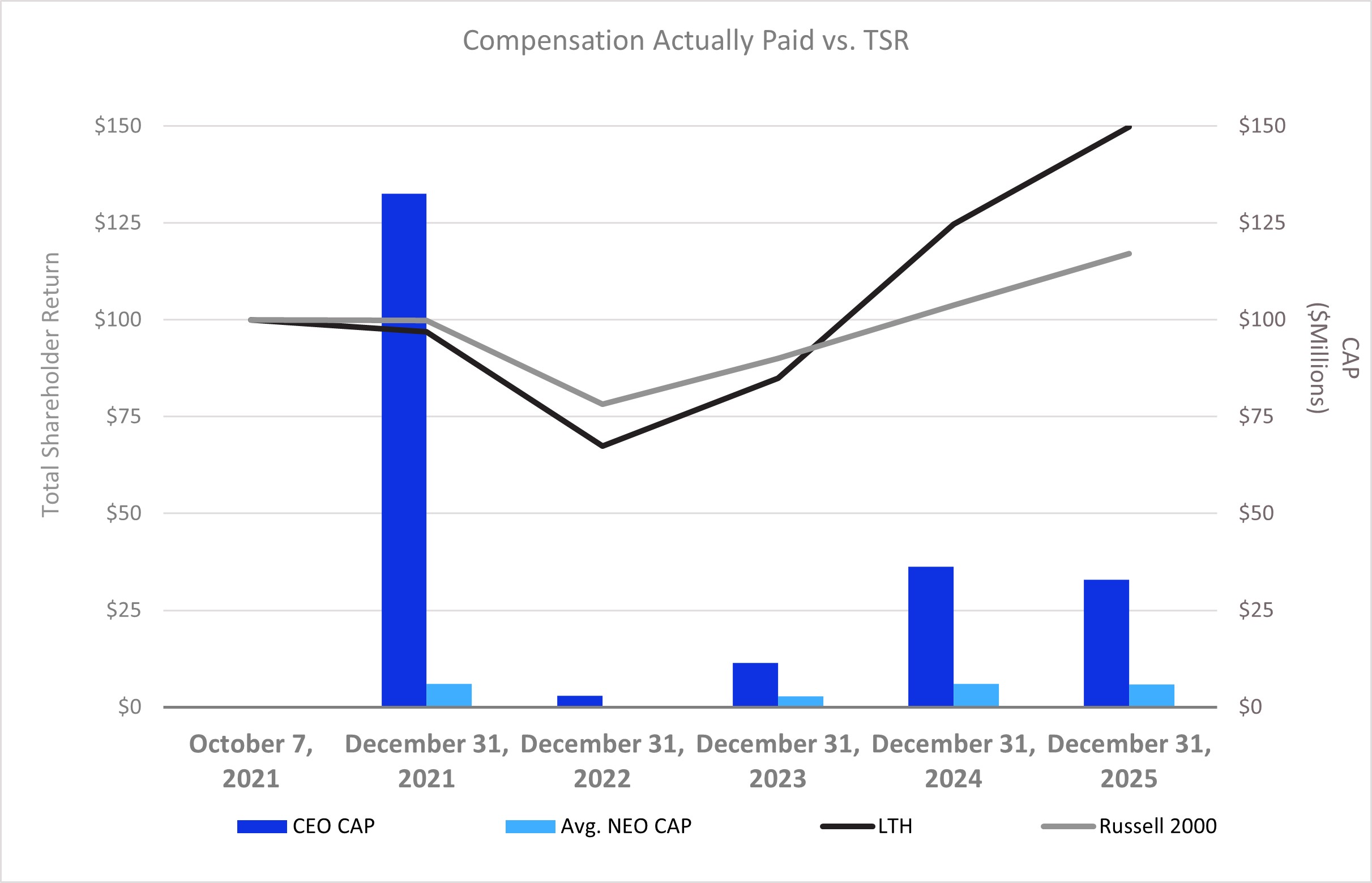
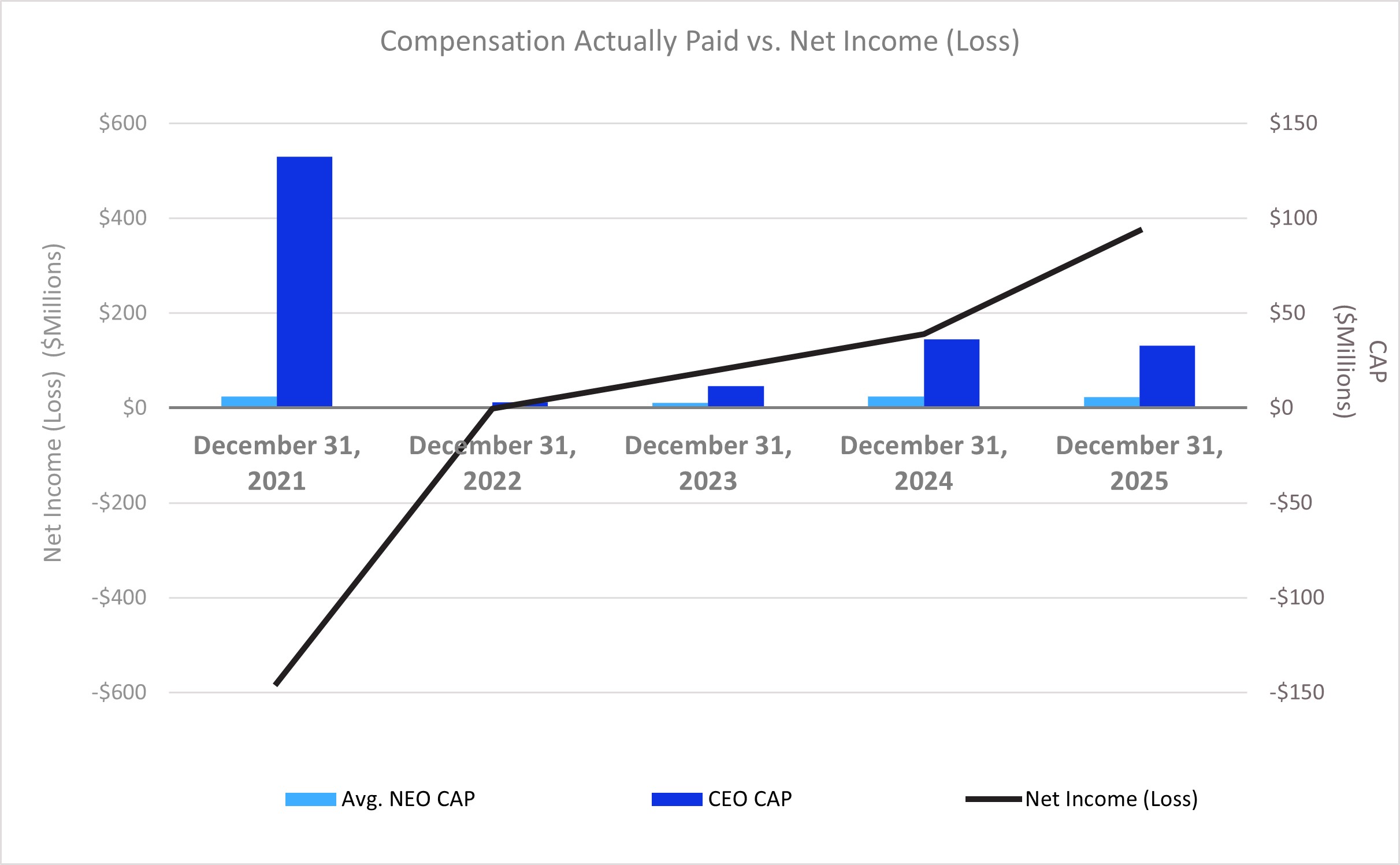
54
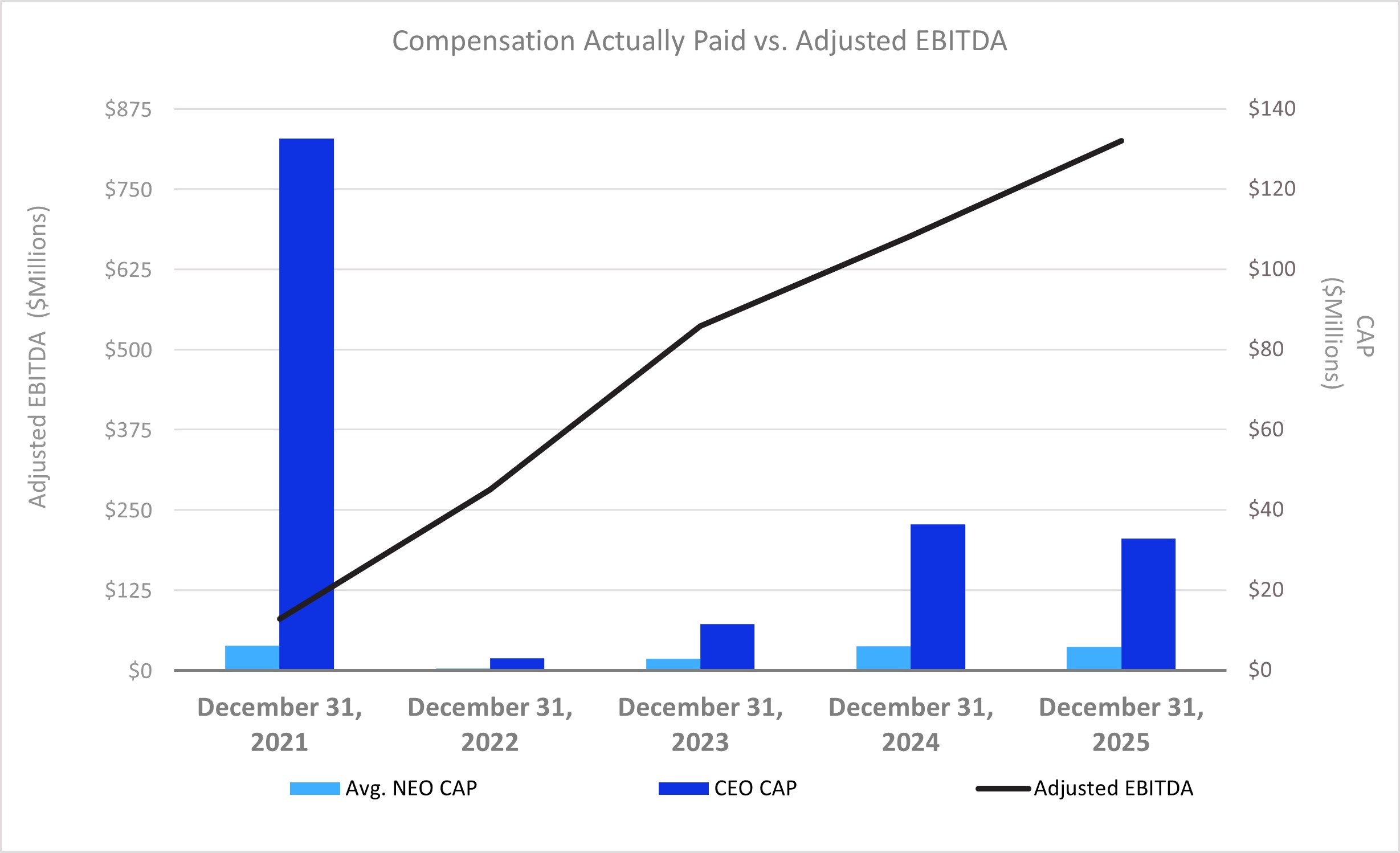
Compensation Actually Paid to Mr. Akradi for the year-ended December 31, 2021, as reflected in the graphics above, is primarily comprised of an option award granted in 2015 that vested in connection with our IPO in October 2021. Mr. Akradi exercised this option award in full on February 27, 2025.
Net income for the year-ended December 31, 2025 included $39.2 million of tax-effected share-based compensation expense, tax-effected net cash proceeds of $41.3 million received from employee retention credits under the CARES Act, tax-effected net cash proceeds of $29.2 million received in partial satisfaction of legal claims, $12.6 million of income tax benefits due to a significant exercise by our Chief Executive Officer of stock options that were set to expire in 2025, and tax-effected one-time gains of $9.7 million on sale-leaseback transactions. Net income for the year-ended December 31, 2024 included $38.2 million of tax-effected share-based compensation expense and a $10.4 million tax-effected loss on debt extinguishment, partially offset by a $2.0 million tax-effected gain on sale-leaseback transactions and a $3.7 million tax-effected gain on the sale of land. Net income for the year-ended December 31, 2023 included $40.2 million of tax-effected share-based compensation expense and a $10.9 million tax-effected loss on sale-leaseback transactions. Net loss for the year-ended December 31, 2022 included a $66.9 million tax-effected gain on sale-leaseback transactions associated with nine of our properties, partially offset by $25.5 million of tax-effected non-cash share-based compensation expense. Net loss for the year-ended December 31, 2021 included $269.1 million of tax-effected non-cash share-based compensation expense and $68.6 million of one-time tax-effected additional interest expense incurred in connection with the conversion of a related-party secured note into preferred stock, debt refinancing and the partial pay down of our term loan.
Tabular List of Important Financial Performance Measures
The following table lists the most important financial measures we used to link Compensation Actually Paid to the NEOs for fiscal 2025 to our performance:
See the Appendix for our definition and reconciliation of Adjusted EBITDA.
55
PROPOSAL 2: ADVISORY (NON-BINDING) VOTE TO APPROVE
THE COMPANY’S NAMED EXECUTIVE OFFICER COMPENSATION (“SAY-ON-PAY”)
The Dodd-Frank Wall Street Reform and Consumer Protection Act of 2010 (the “Dodd-Frank Act”) enables our stockholders to vote to approve, on an advisory (non-binding) basis, the compensation of our Named Executive Officers as disclosed in this Proxy Statement in accordance with the SEC’s rules.
As described in detail under the heading “Compensation Discussion and Analysis,” our executive compensation program is designed to attract, develop, motivate and retain our Named Executive Officers, who are critical to our success. Under these programs, our Named Executive Officers are rewarded for the achievement of strategic goals and the realization of increased stockholder value. Please read the “Compensation Discussion and Analysis” for additional details about our executive compensation program, including information about the fiscal 2025 compensation of our Named Executive Officers.
We are asking our stockholders to indicate their support for our Named Executive Officers’ compensation as described in this Proxy Statement. This proposal, commonly known as a “say-on-pay” vote, gives our stockholders the opportunity to express their views on our Named Executive Officers’ compensation. The stockholders have determined the “say-on-pay” vote shall occur annually. This vote is not intended to address any specific item of compensation, but rather the overall compensation of our Named Executive Officers and the philosophy, policies and practices described in this Proxy Statement.
In accordance with the requirements of Section 14A of the Exchange Act (which was added by the Dodd-Frank Act) and the related rules of the SEC, the Board of Directors will request your advisory vote on the following resolution at the Annual Meeting:
RESOLVED, that the compensation paid to the Named Executive Officers, as disclosed in this Proxy Statement pursuant to the SEC’s executive compensation disclosure rules (which disclosure includes the Compensation Discussion and Analysis, the compensation tables and the narrative discussion that accompanies the compensation tables), is hereby approved.
This “say-on-pay” vote is advisory, and therefore not binding on the Company, the Compensation Committee or the Board of Directors. The Board of Directors and the Compensation Committee value the opinions of our stockholders, and to the extent there is any significant vote against the Named Executive Officer compensation as disclosed in this Proxy Statement, we will consider our stockholders’ concerns and the Compensation Committee will evaluate whether any actions are necessary to address those concerns.
THE BOARD OF DIRECTORS RECOMMENDS A VOTE “FOR” THE ADVISORY SAY-ON-PAY VOTE.
56
EQUITY COMPENSATION PLAN INFORMATION
The following table provides certain information with respect to all of our equity compensation plans as of December 31, 2025:
Plan Category | Number of securities to be issued upon exercise of outstanding options, warrants and rights | Weighted average exercise price of outstanding options, warrants and rights ($) | Number of securities remaining available for future issuance under equity compensation plans (excluding securities reflected in column (a)) | ||||||||
(a) | (b) | (c) | |||||||||
Equity compensation plans approved by stockholders | 12,596,393 (1) | 15.45 (2) | 13,518,594 (3) | ||||||||
Equity compensation plans not approved by stockholders | — | — | — | ||||||||
Total | 12,596,393 (1) | 15.45 (2) | 13,518,594 (3) | ||||||||
(1) Amount includes shares of common stock issuable under our 2015 Equity Incentive Plan and our 2021 Plan.
(2) Excludes restricted stock units and performance stock units, which have no exercise price.
(3) Includes 11,260,012 shares available for future issuance under our 2021 Plan and 2,258,582 shares available under our 2021 Employee Stock Purchase Plan (the “ESPP”). The number of shares available for issuance under our 2021 Plan increases automatically on the first day of each calendar year beginning January 1, 2022 and ending on and including January 1, 2031, in an amount equal to the lesser of (i) 4% of the aggregate number of outstanding shares of our common stock on the final day of the immediately preceding calendar year and (ii) such smaller number of shares determined by our Board. The number of shares available for issuance under the ESPP increases automatically on the first day of each calendar year beginning January 1, 2022 and ending on and including January 1, 2031, in an amount equal to the lesser of (a) 1% of the aggregate number of outstanding shares of our common stock on the final day of the immediately preceding calendar year and (ii) such smaller number of shares determined by our Board. The Board determined that no shares would be added to either our 2021 Plan or the ESPP as of January 1, 2024, January 1, 2025 or January 1, 2026.
57
INDEPENDENT REGISTERED PUBLIC ACCOUNTING FIRM DISCLOSURE
Fees
The following is a summary of the fees and services provided by Deloitte & Touche LLP (“Deloitte”) to the Company for fiscal years 2025 and 2024:
Fiscal Year Ended December 31, | ||||||||
Description of Services Provided by Deloitte | 2025 ($) | 2024 ($) | ||||||
Audit Fees (1) | 2,026,545 | 1,944,371 | ||||||
Audit-Related Fees (2) | 407,223 | 294,596 | ||||||
Tax Fees (3) | 805,660 | 636,675 | ||||||
All Other Fees | — | — | ||||||
TOTAL | 3,239,428 | 2,875,642 | ||||||
(1) Audit fees for 2025 and 2024 include professional services rendered in connection with the audit of our consolidated financial statements and the effectiveness of our internal control over financial reporting for the years ended December 31, 2025 and December 31, 2024; the reviews of the consolidated financial statements included in each of our Quarterly Reports on Form 10-Q during the years ended December 31, 2025 and December 31, 2024; and consultation on accounting matters.
(2) Audit-related fees for 2025 and 2024 include professional services rendered in connection with audits of one of our joint ventures, our Life Time Foundation and our 401(k) retirement savings plan. Additionally, fees for 2024 include professional services rendered in connection with non-recurring audit-related transactions.
(3) Tax fees for 2025 and 2024 were for general consulting and tax compliance services.
The Audit Committee pre-approves the scope of the audit, audit-related and tax services provided by our independent registered public accounting firm, as well as all associated fees and terms, pursuant to pre-approval policies and procedures established by the Audit Committee. The Audit Committee evaluates the independent registered public accounting firm’s qualifications, performance and independence, and presents its conclusions to the full Board of Directors on at least an annual basis.
All of the services provided by Deloitte in fiscal years 2025 and 2024, and the fees for such services, were pre-approved by the Audit Committee in accordance with these standards.
58
REPORT OF THE AUDIT COMMITTEE OF THE BOARD OF DIRECTORS
The Audit Committee reviews the Company’s financial reporting process on behalf of the Board of Directors. Management has the primary responsibility for the preparation and integrity of the consolidated financial statements and the reporting process, including establishing and monitoring the system of internal financial controls. In this context, during fiscal year 2025, the Audit Committee met and held discussions with management and Deloitte, the Company’s independent registered public accounting firm. Management has represented to the Audit Committee that the Company’s consolidated financial statements for the fiscal year ended December 31, 2025, were prepared in accordance with accounting principles generally accepted in the United States of America, and the Audit Committee has reviewed and discussed the audited financial statements of the Company with management of the Company and with Deloitte.
In addition, the Audit Committee has reviewed and discussed with Deloitte: (i) the matters required to be discussed by the applicable requirements of the Public Company Accounting Oversight Board (the “PCAOB”), and the SEC; and (ii) the written disclosures and the letter received from Deloitte required by applicable requirements of the PCAOB regarding Deloitte’s communications with the Audit Committee concerning independence and the independence of Deloitte from the Company and its management.
Based on the review and discussion referred to above, the Audit Committee recommended to the Board of Directors that the audited financial statements be included in the Company’s Annual Report on Form 10-K for the fiscal year ended December 31, 2025 for filing with the SEC.
Audit Committee | ||
Donna Coallier, Chair
Jimena Almendares
Joel Alsfine
Jennifer Pomerantz
59
PROPOSAL 3: RATIFICATION OF THE SELECTION OF THE INDEPENDENT REGISTERED PUBLIC ACCOUNTING FIRM
The Audit Committee has selected Deloitte as the Company’s independent registered public accounting firm for the fiscal year ending December 31, 2026, and the Board of Directors is submitting this selection to our stockholders for ratification at the Annual Meeting. Deloitte has served as our independent registered public accounting firm since 2002. Representatives of Deloitte plan to attend the Annual Meeting and will be available to answer appropriate questions from stockholders. They will have the opportunity to make a statement if they desire to do so.
Neither our Bylaws nor other governing documents or law require stockholder ratification of the selection of Deloitte as the Company’s independent registered public accounting firm. However, the Board of Directors is submitting the selection of Deloitte to the stockholders for ratification as a matter of good corporate practice. If the stockholders fail to ratify the selection, the Audit Committee will reconsider whether to retain Deloitte. Even if the selection is ratified, the Audit Committee in its discretion may direct the appointment of a different independent registered public accounting firm at any time during the year if the Audit Committee determines that such a change would be in the best interest of the Company and its stockholders.
THE BOARD OF DIRECTORS RECOMMENDS A VOTE “FOR” THE RATIFICATION OF DELOITTE AS THE COMPANY’S INDEPENDENT REGISTERED PUBLIC ACCOUNTING FIRM FOR THE FISCAL YEAR ENDING DECEMBER 31, 2026.
60
CERTAIN RELATIONSHIPS AND RELATED PERSON TRANSACTIONS
Our Policy Regarding Related Person Transactions
The Board of Directors recognizes the fact that transactions with related persons present a heightened risk of conflicts of interests or improper valuation (or the perception thereof). The Board of Directors adopted a written policy on transactions with related persons that is in conformity with the requirements for issuers having publicly held common stock that is listed on the NYSE. Under such policy:
•any related person transaction, and any material amendment or modification to a related person transaction, must be reviewed and approved or ratified by the disinterested members of the Audit Committee or the full Board of Directors; and
•any employment relationship or transaction involving an executive officer and any related compensation must be approved by the Compensation Committee or recommended by the Compensation Committee to the Board of Directors for its approval.
In connection with the review and approval or ratification of a related person transaction:
•management must disclose to the disinterested members of the Audit Committee or the full Board, as applicable, the name of the related person and the basis on which the person is a related person, the material terms of the related person transaction, including the approximate dollar value of the amount involved in the transaction and all the material facts as to the related person’s direct or indirect interest in, or relationship to, the related person transaction;
•management must advise the disinterested members of the Audit Committee or the full Board, as applicable, if the related person transaction conflicts with the terms of our agreements governing our material outstanding indebtedness that limit or restrict our ability to enter into a related person transaction;
•management must advise the disinterested members of the Audit Committee or the full Board, as applicable, as to whether the related person transaction will be required to be disclosed in our applicable filings under the Securities Act or the Exchange Act, and related rules, and, to the extent required to be disclosed, management must ensure that the related person transaction is disclosed in accordance with such Acts and related rules; and
•management must advise the disinterested members of the Audit Committee or the full Board, as applicable, as to whether the related person transaction constitutes a “personal loan” for purposes of Section 402 of the Sarbanes-Oxley Act.
In addition, the related person transaction policy provides that the disinterested members of the Audit Committee or the full Board, as applicable, in connection with any approval or ratification of a related person transaction involving a non-employee director or director nominee, should consider whether such transaction would compromise the director or director nominee’s status as an “independent” or “outside” director, as applicable, under the rules and regulations of the SEC, the NYSE and the Code.
Related Person Transactions
The following is a description of transactions to which we were a party since January 1, 2025 in which the amount involved exceeded or will exceed $120,000, and in which any of our executive officers, directors or holders of more than 5% of any class of our voting securities, or an affiliate or immediate family member thereof, had or will have a direct or indirect material interest.
Leases
In October 2003, we leased a center located within a shopping center that is owned by a general partnership in which Mr. Akradi, our Founder, Chairman and Chief Executive Officer, has a 100% interest. During the year ended December 31, 2025, we paid rent pursuant to this lease agreement of $1.0 million. The terms of the original lease were negotiated by one of our then-independent directors on behalf of the Company and were reviewed and approved by a majority of our then-independent and disinterested directors. In 2015, upon the approval of the Board of Directors, we exercised a renewal option associated with the original lease. In 2016, due to the fact that the square footage of the center was expanded and upon approval of the Board of Directors, we entered into an amended lease agreement. Under the terms of the amended lease agreement, the lease term was extended and the minimum rental payments were adjusted to reflect the increased square footage. In 2023, upon
61
approval of the Audit Committee, we again amended this lease agreement to reflect further expansion of the square footage that we are using at this location and to correspondingly increase the annual rental payments by approximately $110,000. The current lease expires in December 2030 and includes four five-year renewal options.
In 2015, Mr. Akradi, our Founder, Chairman and Chief Executive Officer, through two limited liability companies in which he had a 100% interest, acquired the Woodbury, Minnesota facility that we have occupied and operated as a tenant since 1995. In 2020, Mr. Akradi contributed his ownership of our center in Woodbury, Minnesota to a limited liability company jointly owned by him, a former executive officer and Mr. Lasher, a member of the Board of Directors, among other investors (“LTRE”). Following this contribution, we terminated our existing lease with the entities owned by Mr. Akradi and entered into a new lease for the Woodbury center with subsidiaries of LTRE. The new lease has an initial term of 20 years and includes four renewal options of five years each. During the year ended December 31, 2025, we paid rent pursuant to the lease of $1.2 million.
Sale-Leaseback Transactions
During the year ended December 31, 2017, we entered into sale-leaseback transactions involving two properties, with a limited liability company that is a related party to one of our stockholders, LNK. Each lease expires in September 2042 and includes six five-year renewal options. During the year ended December 31, 2025, we paid rent pursuant to these leases of $6.6 million.
During the year ended December 31, 2018, we entered into a sale-leaseback transaction involving one property, with a limited liability company in which Mr. Akradi, our Founder, Chairman and Chief Executive Officer, owns a 33% interest. The initial lease term expires in June 2043 and includes two eight-year renewal options. During the year ended December 31, 2025, we paid rent pursuant to this lease of $1.3 million.
During the year ended December 31, 2019, we entered into a sale-leaseback transaction involving one property, with a limited liability company jointly owned by Mr. Akradi, our Founder, Chairman and Chief Executive Officer, and Mr. Lasher, a member of the Board of Directors. The lease has an initial term of approximately 25 years and includes five renewal options of five years each. During the year ended December 31, 2025, we paid rent pursuant to this lease of $2.4 million.
During the year ended December 31, 2020, we entered into a sale-leaseback transaction involving one property, with a subsidiary of LTRE. The lease has an initial term of approximately 25 years and includes six renewal options of five years each. During the year ended December 31, 2025, we paid rent pursuant to this lease of $2.7 million.
During the year ended December 31, 2024, we entered into a sale-leaseback transaction involving one property, with a third party in which Mr. Akradi, our Founder, Chairman and Chief Executive Officer, and Mr. Lasher, a member of the Board of Directors, own a minority interest. The lease has an initial term of approximately 25 years and includes five renewal options of five years each. During the year ended December 31, 2025, we paid rent pursuant to this lease of $2.9 million.
Stockholders Agreement
The Stockholders Agreement includes provisions pursuant to which we grant the right to cause us, in certain instances, at our expense, to file registration statements under the Securities Act covering resales of our common stock held by LGP and TPG, and the right to the Principal Stockholders and certain other stockholders to piggyback on such registration statements in certain circumstances. These shares represented approximately 38.3% of our common stock as of December 31, 2025. These shares also may be sold under Rule 144 of the Securities Act, depending on their holding period and subject to restrictions in the case of shares held by persons deemed to be our affiliates or other restrictions in the Stockholders Agreement. The Stockholders Agreement also requires us to indemnify such stockholders in connection with any registrations of our securities.
In addition, the Stockholders Agreement provides that, subject to certain stock ownership thresholds set forth therein, certain of the Principal Stockholders are entitled to designate individuals to be included in the slate of nominees recommended by the Board of Directors for election to the Board of Directors, so as to ensure that the composition of the Board of Directors complies with the provisions of the Stockholders Agreement. In addition, the Principal Stockholders have agreed to vote their shares of our common stock in favor of the election of such nominees. See “Corporate Governance—Director Nomination Process—Nomination Rights under the Stockholders Agreement.”
62
Other
Meghan Akradi, the daughter of Mr. Akradi, our Founder, Chairman and Chief Executive Officer, currently serves as Vice President, Real Estate and Location Intelligence for Life Time. During the year ended December 31, 2025, she received total compensation of approximately $506,000 for her services.
In the ordinary course of our business, we may purchase products and services from certain companies in which holders of more than 5% of our common stock have a material interest. During 2025, we purchased:
•Video services from DIRECTV. TPG has an ownership interest in DIRECTV. During the year ended December 31, 2025, we purchased services from DIRECTV in the amount of approximately $382,000.
•Branded products to offer and sell to our members from Halo Branded Solutions (“Halo”). TPG has an ownership interest in Halo. During the year ended December 31, 2025, we purchased products from Halo in the amount of approximately $975,000.
•Laundry and towel services and products from ImageFIRST Uniform Rental (“ImageFIRST”). TPG has an ownership interest in ImageFIRST. During the year ended December 31, 2025, we procured services and products from ImageFIRST for approximately $1,280,000.
•Information technology and digital media consulting and staff augmentation services from Insight Global LLC (“Insight”). LGP has an ownership interest in Insight. During the year ended December 31, 2025, we procured services from Insight for approximately $677,000.
•Quality toys and learning activities for our Kids Academy within our club locations and bundled products for our new club openings from Lakeshore Learning Materials LLC (“Lakeshore Learning”). LGP has an ownership interest in Lakeshore Learning. During the year ended December 31, 2025, we procured products from Lakeshore Learning for approximately $140,000.
•Day-to-day maintenance, repair and operations products from Parts Town, LLC and its affiliates (“Parts Town”). LGP has an ownership interest in Parts Town. During the year ended December 31, 2025, we procured services and products from Parts Town for approximately $470,000.
•Commercial roofing and related services from Tecta America Corporation and its affiliates (“Tecta”). LGP has an ownership interest in Tecta. During the year ended December 31, 2025, we purchased services from Tecta in the amount of approximately $1,165,000.
63
HOUSEHOLDING OF PROXY MATERIALS
The SEC has adopted rules that permit companies and intermediaries (e.g., brokers) to satisfy the delivery requirements for the Notice or other proxy materials with respect to two or more stockholders sharing the same address by delivering a single Notice or other proxy materials addressed to those stockholders. This process, which is commonly referred to as householding, potentially provides extra convenience for stockholders and cost savings for companies. Stockholders who participate in householding will continue to be able to access and receive separate proxy cards.
The Notice or our proxy materials will be delivered in one single envelope to multiple stockholders sharing an address unless contrary instructions have been received from one or more of the affected stockholders. Once you have received notice from your broker that they will be householding communications to your address, householding will continue until you are notified otherwise or until you revoke your consent with your broker. Upon written request to Secretary, Life Time Group Holdings, Inc., 2902 Corporate Place, Chanhassen, Minnesota 55317, or by telephone at (952) 947-0000, we will deliver promptly a separate copy of the Notice and, if applicable, our proxy materials to any stockholder at a shared address to which we delivered a single copy of any of these materials. To receive a separate copy, or, if a stockholder or stockholders sharing the same address are receiving multiple copies, to request that we only send a single copy of the Notice and, if applicable, our proxy materials, please contact your broker if you are a beneficial holder through a broker, or, if you are a registered holder, contact our transfer agent, Equiniti Trust Company, LLC.
OTHER MATTERS
The Board knows of no other matters that will be presented for consideration at the Annual Meeting. If any other matters are properly brought before the Annual Meeting, it is the intention of the persons named in the accompanying proxy to vote on such matters in accordance with their best judgment.
A copy of our Annual Report on Form 10-K for the year ended December 31, 2025, as filed with the SEC on February 24, 2026, is available without charge upon written request to Investor Relations, Life Time Group Holdings, Inc., 2902 Corporate Place, Chanhassen, Minnesota 55317 or by accessing a copy on Life Time’s website at
https://ir.lifetime.life in the SEC Filings section under “Annual Reports.” Information on or accessible through our website is not incorporated by reference in this Proxy Statement.
64
APPENDIX
SUPPLEMENTAL NON-GAAP FINANCIAL INFORMATION USED IN
COMPENSATION PERFORMANCE METRICS
Our consolidated financial statements are prepared and presented in accordance with generally accepted accounting principles in the United States (“GAAP”). The Proxy Statement, including the “Compensation Discussion and Analysis” and “Pay Versus Performance” subsections of the Executive Compensation section, contains references to certain financial measures that are not presented in accordance with GAAP, including Adjusted EBITDA and our leverage ratio. These non-GAAP financial measures are not based on any comprehensive set of accounting rules or principles and should be considered in addition to, and not as a substitute for or superior to, net income as a measure of financial performance, total debt (defined as long-term debt, net of current portion, plus current maturities of debt) as a measure of financial performance or liquidity or any other performance measure derived in accordance with GAAP, and should not be construed as an inference that the Company’s future results will be unaffected by unusual or non-recurring items. In addition, these non-GAAP financial measures should be read in conjunction with the Company’s financial statements prepared in accordance with GAAP. The reconciliations of the Company’s non-GAAP financial measures to the corresponding GAAP measures should be carefully evaluated. You are encouraged to evaluate these adjustments and the reasons we consider them appropriate for supplemental analysis. In evaluating the non-GAAP financial measures, you should be aware that, in the future, we may incur expenses that are the same as or similar to some of the adjustments in our presentation of our non-GAAP financial measures. There can be no assurance that we will not modify the presentation of non-GAAP financial measures in future periods, and any such modification may be material. In addition, our non-GAAP financial measures may not be comparable to similarly titled measures used by other companies in our industry or across different industries.
We consider Adjusted EBITDA in assessing the performance of our business and comparing our operating performance across reporting periods on a consistent basis by excluding items that we do not believe are indicative of our ongoing operating performance. We consider our leverage ratio in assessing the performance of our business and the strength of our balance sheet and liquidity. We also use Adjusted EBITDA and our leverage ratio as compensation performance measures.
We define Adjusted EBITDA as net income before interest expense, net, provision for income taxes and depreciation and amortization, excluding the impact of share-based compensation expense as well as (gain) loss on sale-leaseback transactions, capital transaction costs, legal settlements, asset impairment, severance and other items that are not indicative of our ongoing operations. Adjusted EBITDA margin is calculated as Adjusted EBITDA divided by total revenue. Net debt is defined as long-term debt, net of current portion, plus current maturities of debt, excluding fair value adjustments, unamortized debt discounts and issuance costs, minus cash and cash equivalents. Net debt is as of the last day of the respective quarter or year. Our leverage ratio is calculated as our net debt divided by our trailing twelve months of Adjusted EBITDA.
The following table provides a reconciliation of net income, the most directly comparable GAAP measure, to Adjusted EBITDA:
Year Ended December 31, | |||||||||||||||||
($ in thousands) | 2025 | 2024 | 2023 | ||||||||||||||
Net income | $ | 373,671 | $ | 156,240 | $ | 76,063 | |||||||||||
Interest expense, net of interest income (a) | 82,263 | 148,095 | 130,797 | ||||||||||||||
Provision for income taxes | 119,832 | 52,528 | 18,727 | ||||||||||||||
Depreciation and amortization | 296,345 | 274,681 | 244,397 | ||||||||||||||
Share-based compensation expense (b) | 51,750 | 51,034 | 50,144 | ||||||||||||||
(Gain) loss on sale-leaseback transactions (c) | (12,785) | (2,618) | 13,624 | ||||||||||||||
Capital transaction costs (d) | 1,531 | — | — | ||||||||||||||
Legal settlements (e) | (38,629) | 1,815 | 787 | ||||||||||||||
Asset impairments (f) | 5,791 | — | 6,620 | ||||||||||||||
Employee retention credits (g) | (54,572) | — | — | ||||||||||||||
Other (h) | (22) | (4,995) | (4,328) | ||||||||||||||
Adjusted EBITDA | $ | 825,175 | $ | 676,780 | $ | 536,831 | |||||||||||
65
(a) Includes (i) a $13.8 million write-off of the unamortized debt discounts and issuance costs associated with the extinguishment of our former term loan facility and construction loan and the loss on the satisfaction and discharge of our 5.750% Senior Secured Notes and 8.000% Senior Unsecured Notes for the year ended December 31, 2024.
(b) Share-based compensation expense recognized during the year ended December 31, 2025 was associated with stock options, restricted stock units, performance stock units, our employee stock purchase plan (“ESPP”) and liability-classified awards related to our 2025 Bonus Plan. Share-based compensation expense recognized during the year ended December 31, 2024 was associated with stock options, restricted stock units, performance stock units, our ESPP and liability-classified awards related to our 2024 short-term incentive plan. Share-based compensation expense recognized during the year ended December 31, 2023 was associated with stock options, restricted stock units, our ESPP and liability-classified awards related to our 2023 short-term incentive plan.
(c) We adjust for the impact of gains or losses on the sale-leaseback of our properties as they do not reflect costs associated with our ongoing operations. For details on the (gain) loss on the sale-leaseback transactions that we recognized during the years ended December 31, 2025, 2024 and 2023, see “Sale-Leaseback Transactions” within Note 10, Leases, to our consolidated financial statements in Part II, Item 8 of our Annual Report on Form 10-K for the year ended December 31, 2025.
(d) Represents one-time costs related to capital transactions, including debt and equity offerings that are non-recurring in nature.
(e) We adjust for the impact of unusual legal settlements or judgments as these costs and proceeds are non-recurring in nature and do not reflect costs or proceeds associated with our normal ongoing operations. Nearly all of the adjustment for the year ended December 31, 2025 is payment of approximately $40 million by Zurich American Insurance Company (“Zurich”) in partial satisfaction of legal claims against Zurich for its failure to provide certain business interruption insurance coverage related to the government-ordered suspensions of our club operations in 2020 during the COVID-19 pandemic, representing payment of up to $1.0 million plus interest for 26 occurrences of 29 total occurrences found by the Minnesota Court of Appeals in an order dated August 11, 2025. This payment is offset by legal-related expenses in pursuit of our claim against Zurich of $1.0 million, $0.6 million and $0.8 million for the years ended December 31, 2025, 2024 and 2023, respectively. This adjustment also includes $1.3 million of other costs related to unusual legal settlements or judgments for the year ended December 31, 2024.
(f) Represents non-cash asset impairments of our long-lived assets related to non-club businesses, excluding impairments on development costs that are part of our normal course of business.
(g) Represents refundable payroll tax credits for employee retention under the CARES Act.
(h) Includes (i) (gain) loss on sales of land of $(5.0) million and $0.4 million for the years ended December 31, 2024 and 2023, respectively, (ii) gain on sales of the Company’s triathlons and certain other assets of $(4.9) million for the year ended December 31, 2023, (iii) executive level severance of $0.5 million for the year ended December 31, 2023, and (iv) other immaterial transactions that are unusual or non-recurring in nature of $(0.3) million for the year ended December 31, 2023.
The following table provides a reconciliation of total debt, the most directly comparable GAAP measure, to Net debt leverage ratio:
Year Ended December 31, | |||||||||||||||||
($ in thousands) | 2025 | 2024 | 2023 | ||||||||||||||
Current maturities of debt | $ | 21,848 | $ | 22,584 | $ | 73,848 | |||||||||||
Long-term debt, net of current portion | 1,485,939 | 1,513,157 | 1,859,027 | ||||||||||||||
Total Debt | $ | 1,507,787 | $ | 1,535,741 | $ | 1,932,875 | |||||||||||
Less: Fair value adjustment | 130 | 284 | 521 | ||||||||||||||
Less: Unamortized debt discounts and issuance costs | (17,576) | (19,856) | (15,270) | ||||||||||||||
Less: Cash and cash equivalents | 204,807 | 10,879 | 11,161 | ||||||||||||||
Net Debt | $ | 1,320,426 | $ | 1,544,434 | $ | 1,936,463 | |||||||||||
Trailing twelve-month Adjusted EBITDA | 825,175 | 676,780 | 536,831 | ||||||||||||||
Net Debt Leverage Ratio | 1.6x | 2.3x | 3.6x | ||||||||||||||
66
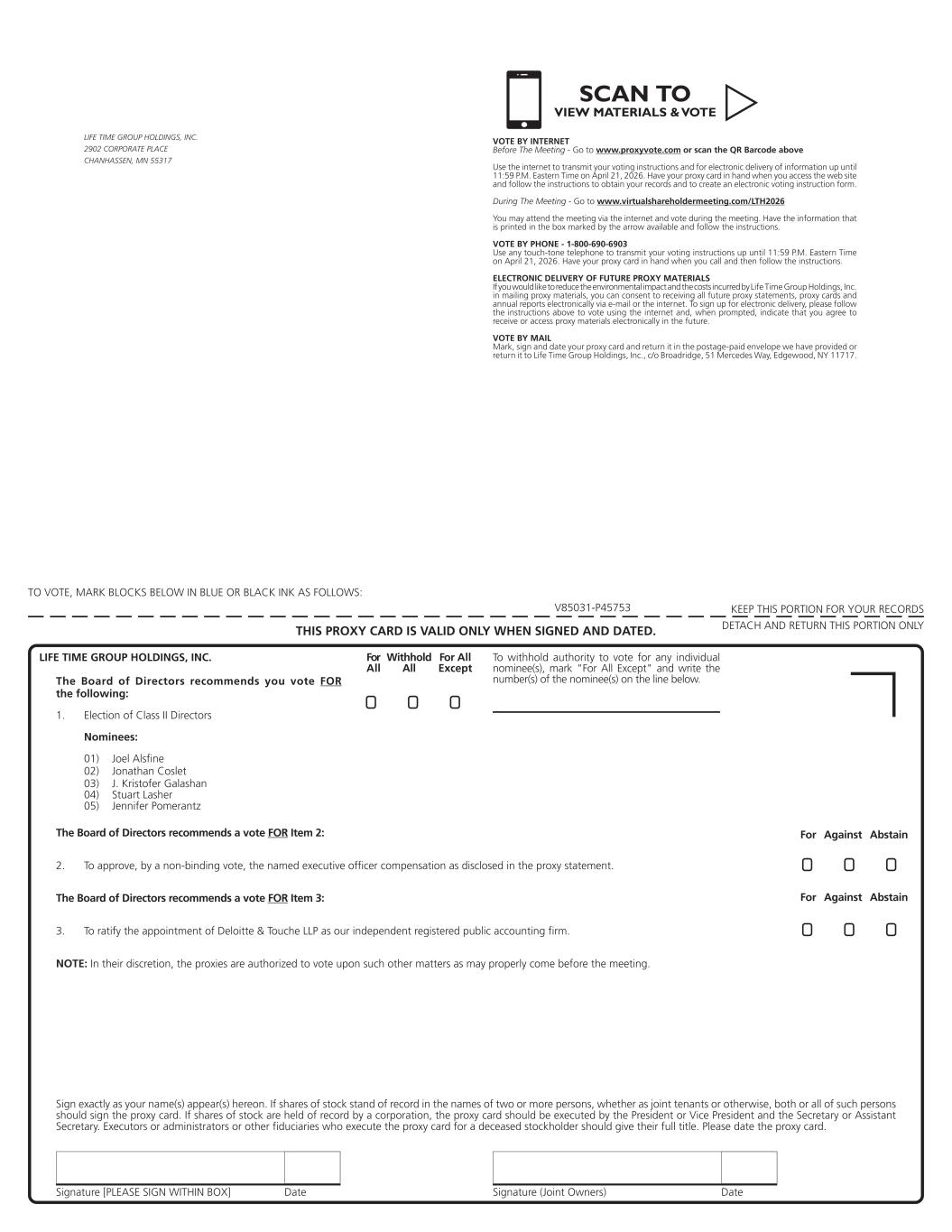
Signature [PLEASE SIGN WITHIN BOX] Date Signature (Joint Owners) Date TO VOTE, MARK BLOCKS BELOW IN BLUE OR BLACK INK AS FOLLOWS: KEEP THIS PORTION FOR YOUR RECORDS DETACH AND RETURN THIS PORTION ONLYTHIS PROXY CARD IS VALID ONLY WHEN SIGNED AND DATED. V85031-P45753 ! ! ! For All Withhold All For All Except ! !! ! !! To withhold authority to vote for any individual nominee(s), mark "For All Except" and write the number(s) of the nominee(s) on the line below. LIFE TIME GROUP HOLDINGS, INC. 01)	 Joel Alsfine 02)	 Jonathan Coslet 03)	 J. Kristofer Galashan 04)	 Stuart Lasher 05)	 Jennifer Pomerantz 1.	 Election of Class II Directors 	 Nominees: The Board of Directors recommends you vote FOR the following: The Board of Directors recommends a vote FOR Item 2: The Board of Directors recommends a vote FOR Item 3: 3.	 To ratify the appointment of Deloitte & Touche LLP as our independent registered public accounting firm. NOTE: In their discretion, the proxies are authorized to vote upon such other matters as may properly come before the meeting. 2.	 To approve, by a non-binding vote, the named executive officer compensation as disclosed in the proxy statement. Sign exactly as your name(s) appear(s) hereon. If shares of stock stand of record in the names of two or more persons, whether as joint tenants or otherwise, both or all of such persons should sign the proxy card. If shares of stock are held of record by a corporation, the proxy card should be executed by the President or Vice President and the Secretary or Assistant Secretary. Executors or administrators or other fiduciaries who execute the proxy card for a deceased stockholder should give their full title. Please date the proxy card. For Against Abstain For Against Abstain SCAN TO VIEW MATERIALS & VOTEw LIFE TIME GROUP HOLDINGS, INC. 2902 CORPORATE PLACE CHANHASSEN, MN 55317 VOTE BY INTERNET Before The Meeting - Go to www.proxyvote.com or scan the QR Barcode above Use the internet to transmit your voting instructions and for electronic delivery of information up until 11:59 P.M. Eastern Time on April 21, 2026. Have your proxy card in hand when you access the web site and follow the instructions to obtain your records and to create an electronic voting instruction form. During The Meeting - Go to www.virtualshareholdermeeting.com/LTH2026 You may attend the meeting via the internet and vote during the meeting. Have the information that is printed in the box marked by the arrow available and follow the instructions. VOTE BY PHONE - 1-800-690-6903 Use any touch-tone telephone to transmit your voting instructions up until 11:59 P.M. Eastern Time on April 21, 2026. Have your proxy card in hand when you call and then follow the instructions. ELECTRONIC DELIVERY OF FUTURE PROXY MATERIALS If you would like to reduce the environmental impact and the costs incurred by Life Time Group Holdings, Inc. in mailing proxy materials, you can consent to receiving all future proxy statements, proxy cards and annual reports electronically via e-mail or the internet. To sign up for electronic delivery, please follow the instructions above to vote using the internet and, when prompted, indicate that you agree to receive or access proxy materials electronically in the future. VOTE BY MAIL Mark, sign and date your proxy card and return it in the postage-paid envelope we have provided or return it to Life Time Group Holdings, Inc., c/o Broadridge, 51 Mercedes Way, Edgewood, NY 11717.
V85032-P45753 Important Notice Regarding the Internet Availability of Proxy Materials for the Annual Meeting: The Notice and Proxy Statement and Annual Report on Form 10-K are available at www.proxyvote.com. LIFE TIME GROUP HOLDINGS, INC. PROXY FOR ANNUAL MEETING OF STOCKHOLDERS THIS PROXY IS SOLICITED ON BEHALF OF THE BOARD OF DIRECTORS OF THE COMPANY 	 The undersigned hereby appoints each of Bahram Akradi and Erik Lindseth with full power of substitution, to represent the undersigned and to vote all of the shares of stock in Life Time Group Holdings, Inc. (the "Company") which the undersigned is entitled to vote at the Annual Meeting of Stockholders of the Company, to be held virtually at www.virtualshareholdermeeting.com/LTH2026 on April 22, 2026 at 9:30 a.m. Central Time and at any adjournment or postponement thereof: (1) as hereinafter specified upon the proposals listed on the reverse side and as more particularly described in the Company’s Proxy Statement, receipt of which is hereby acknowledged, and (2) in their best judgment upon such other matters as may properly come before the meeting. 	 The shares represented hereby shall be voted as specified. If no specification is made, such shares shall be voted FOR the election of the nominees listed on the reverse side for the Board of Directors and FOR Items 2 and 3. This proxy will be voted in the discretion of the proxies upon such other matters as may properly come before the Annual Meeting. Whether or not you are able to attend the meeting, you are urged to vote. You may vote by mail, telephone or internet. Please follow the instructions on the reverse side of the card. IF YOU ELECT TO VOTE BY MAIL, PLEASE SIGN, DATE AND RETURN THIS PROXY CARD PROMPTLY USING THE ENCLOSED ENVELOPE (CONTINUED AND TO BE SIGNED ON REVERSE SIDE)